
Image Credit: John Salway
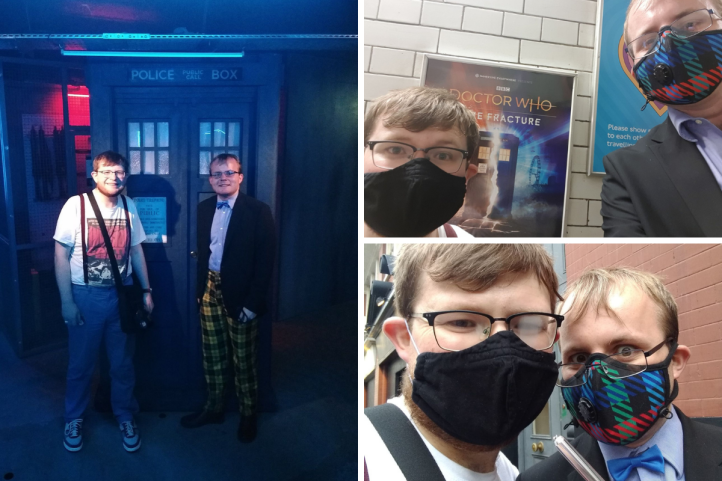
Image Description: Tides‘ Editor and TLV reviewer take on Time Fracture
By John Salway
Name: Time Fracture
Type: Live Immersive Theatre Experience
Price: From £49.95
Current TLV investment: £375.35
Well, this is it! We’ve finally arrived at the last piece of Time Lord Victorious that I’ll be reviewing. It’s a momentous occasion, and thankfully we’ve got a sufficiently exciting event to end on! Originally due to debut in 2020 before COVID-19, Time Fracture was a highly immersive theatrical experience that ran at London’s Immersive|LDN venue near Bond Street from late May 2021 to early June 2022. More than any previous live event, it allowed guests to walk into the world of Doctor Who where they were met with a time-and-space-spanning tale that’s brimming with talent, love and references-a-go-go. I had the privilege of visiting the experience a couple of times during its run, and previously contributed a short, spoiler-free review as part of my ongoing Time Lord Victorious coverage. As the show has now been closed for a while, with no sign of a re-emergence anytime soon, it seems appropriate to look back on the show in a little more detail. If you still wish to remain ignorant of the show’s events in hope of a revival, then read no further. But if you dare to read the secrets within, prepare to enter the Time Fracture…
The adventure begins as you are welcomed to a secret UNIT black site by a somewhat familiar face, before being briefed by a recording of Kate Lethbridge-Stewart (which again seems to be the moniker she’s going by at the moment!). This covered all the basic plot info you needed, repeated (thankfully not ad verbum) from the online clips previously released for those normal folks who don’t obsessively document trailers.
You’re then moved into the first part of the adventure, a large UNIT lab with an intriguing central power device, where the scientists are trying to combat the ever-growing time fracture. As increasingly bizarre events start to occur in the outside world, you spent about 20 to 30 minutes here being introduced to various UNIT members, ducking when systems overload, being relentlessly briefed and re-briefed, and asked to do some minor tasks such as inventing cover stories for various international incidents. It seems to be intended as a sort of ice-breaker, getting the audience used to interacting with the cast and encouraging them to play along with events, at which it succeeds. However, it all seemed quite unfocused, and despite the UNIT actors’ best improvisational skills, there just isn’t that much to see or do in the lab. With the time fracture itself tantalisingly within reach, you’re just willing this introduction to go quicker so you can hurry up, get it opened and venture inside.
Eventually, with the Doctor’s assistance and a snazzy set transformation to reveal a TARDIS console, the time fracture opens. After being beckoned inside, you head down a set of neon-lit stairs into the basement where the real heart of the experience lies. While it’s an exciting moment, the rush to get everyone downstairs could have been improved – there are two different routes which come out at slightly different points, so on one occasion I ended up separated from the rest of my party.
Once downstairs, Time Lord guides (all of whom are implied to be unknown Doctor incarnations) wait to lead small groups of two to eight around the various time zones that have been joined together by the fracture. Each zone is small but perfectly formed, with gorgeous set design, expressive characters and many surprises waiting to unfold. In one moment you might be in an alien marketplace watching the Kerblam! man deliver a mysterious package to a pig-man, while the next you might be crouching through a fireplace to meet Leonardo da Vinci, who’s building an anachronistic gizmo under the gaze of the Silence.
This section of the show is far and away the highlight, as you get to freely interact with the actors and props all around you. To a certain extent, you can also influence where you want to go and what to do next, although this is where your group size can have a large impact. While each area has its own little storyline, there is an overarching plot going on across the showfloor as Time Lord agent Zoria ventures across time zones on a mission to save Gallifrey from the fracture. You’ll likely see her once or twice as you move about, but even if you miss them, the characters across the zones will give you enough information to piece together the gist of what’s going on. My personal favourite moment occurred as my group were shown through a mysterious door, behind which we discovered a control room on Skaro – and Davros himself! This was accomplished superbly, with the actor fully embodying the character as if he’d just rolled out of the television. Crucially, this was no mere cameo, as the sinisterly seductive Davros convinced our party to take an important device with us…
Having visited Time Fracture both during and after certain COVID accommodations were in place, this section was the area with the most obvious change. During our first visit, there was a much smaller intake of guests to each show, and each Time Lord host would guide a very small group of around five people. This meant the show felt a lot more personalised, giving everyone more of a chance to properly interact with the actors around them. On our subsequent trip, groups were around eight or nine, making it more difficult to see and hear the actors. Unless you were in the front, you could feel more like a tagalong to somebody else’s adventure. While I understand that the show probably needed a more dilute actor/guest ratio to make money once they were allowed to, it definitely made for a less enjoyable show.
Your time on the main Time Fracture showfloor ends with the advance of a Cyberman attack squad, forcing guests to flee through newly opened doors to the next time zone – the space liner ZZ1, with its bar and cabaret stage. This is referred to as an ‘intermission’ – you can go to the bathroom and order drinks at the central bar – but the show hasn’t really stopped by any means. As well as some talented live performances by in-character Crespalian and/or Silurian singers, who you can also interact with between sets, , the plot continues in the bar as Zoria gets in a firefight with Time Lord Victorious’ Brian the Ood (yay!). As she secures a case containing the assembled chronometric weapon she has been seeking, the vessel’s destination changes to Gallifrey… This whole section is a real treat, allowing you to sit back and relax, or continue to engage with the immersive experience. It’s probably the best intermission in the business.
The experience’s final section is a lot less open than the rest, but no less immersive for it. Small groups are gathered by the Time Lord guides and directed past the murdered corpse of Brian the Ood (boo!) in pursuit of Zoria through more time fractures to reach Gallifrey. Your first stop – the basement of Henrik’s department store, where, in a surprising twist, you are attacked not by Autons, but Weeping Angels! This scene is expertly choreographed and lit so you never see the Angel actors move as they advance from towards you between flashes of light. As your guide spots a side route, you escape up some stairs to the National Gallery where a time fracture behind the Gallifrey Falls No More painting leads you to said planet.
Once you arrive at Gallifrey, the experience becomes as close as it gets to a traditional stage play. Directed to one of four standing sections around Rassilon’s tomb, each representing one of the great houses of Gallifrey, you watch on as Time Lord officials argue for and against resurrecting Rassilon yet again. It transpires that he will actually cause the time fracture, destroying the rest of the universe to save his people. Rassilon, it seems, is not one for trying out new ideas. Thankfully, help is at hand! Not, as you might expect, from the Doctor, but from Davros, who uses the device he gave us earlier to summon Daleks to Gallifrey, exterminate some Time Lords, and usurp the plot to destroy everything for his own ends. Now is when the Doctor makes their move, as all of their incarnations can be seen and heard around the chamber. While some of the Doctors are soundalikes, most are recorded from the original actors. All 13 Doctors at the time, plus the War and Fugitive Doctors, are there to save the day in a cheesy, but uplifting finale. On the way out, via the UNIT HQ, you are at your leisure to pose for photographs with the newly materialised TARDIS, before emerging into the gift shop which sells show merchandise as well as more general Doctor Who models and figurines.
During my visits, I was unable to get a copy of the show’s program (or Show Companion, as it labels itself) as it had sold out. I’ve since been able to acquire a second-hand copy, revealing it to be a suitably glossy production with a lenticular cover. It’s a well-produced theatrical program, with lots of gorgeous photographs of the sets and brief interviews with various creative figures in the show’s development. While the initial development team are credited in the program itself, the cast and company are featured in their own pull-out section – presumably so this could be updated frequently during the show’s run over multiple cast changes. It’s more than just a program, however, and contains a couple of in-universe pieces of ephemera – letters from the Doctor and Kate Stewart that mainly just reiterate Time Fracture’s central premise, but also implore repeat visitors to keep the show’s secrets safe (err, whoops).
Now we’ve been through the experience, it’s my final time to ask the age-old question: how does this adventure tie into Time Lord Victorious? The answer is very sparingly, and not very well, save an appearance by Brian the Ood. We have heard reference to the time fracture in some other stories, particularly the short story What the TARDIS thought of “Time Lord Victorious”, but this seems to attribute the source of the fracture to the Doctor returning Adelaide Brooke to Earth, which is a completely different explanation to the one given here, so much so that I’m not sure the two can be easily reconciled.
James Goss interjects (via Twitter):
“If it helps, the Doctor’s actions in The Waters of Mars creates the fracture on Davies Street, which the temporal disruptor then opens. But for the show to spend time explaining it would be a chore when there is fun to be had.”
In the original version of this review, I iplored all of you to go out and see Time Fracture at the earliest opportunity. Sadly, this unique and impressive show was cut short by a variety of issues beyond its control, such as the cast coming down with COVID and the venue flooding. That said, the fact that it persevered through these difficulties is a testament to the talented people working both on stage and behind the scenes. While, at the time of writing, the show’s website is still online and encouraging fans to “keep in touch with future opportunities to experience” it, no such news has been forthcoming. If Time Fracture ever does return, I strongly encourage you to attend and experience for yourself the chance to step into a Doctor Who adventure.
Print copies of Tides 49 are, at time of publication, available to buy through this link
 The Tides of Time
[…] Next article […]
LikeLike