
Image Credit: James Ashworth
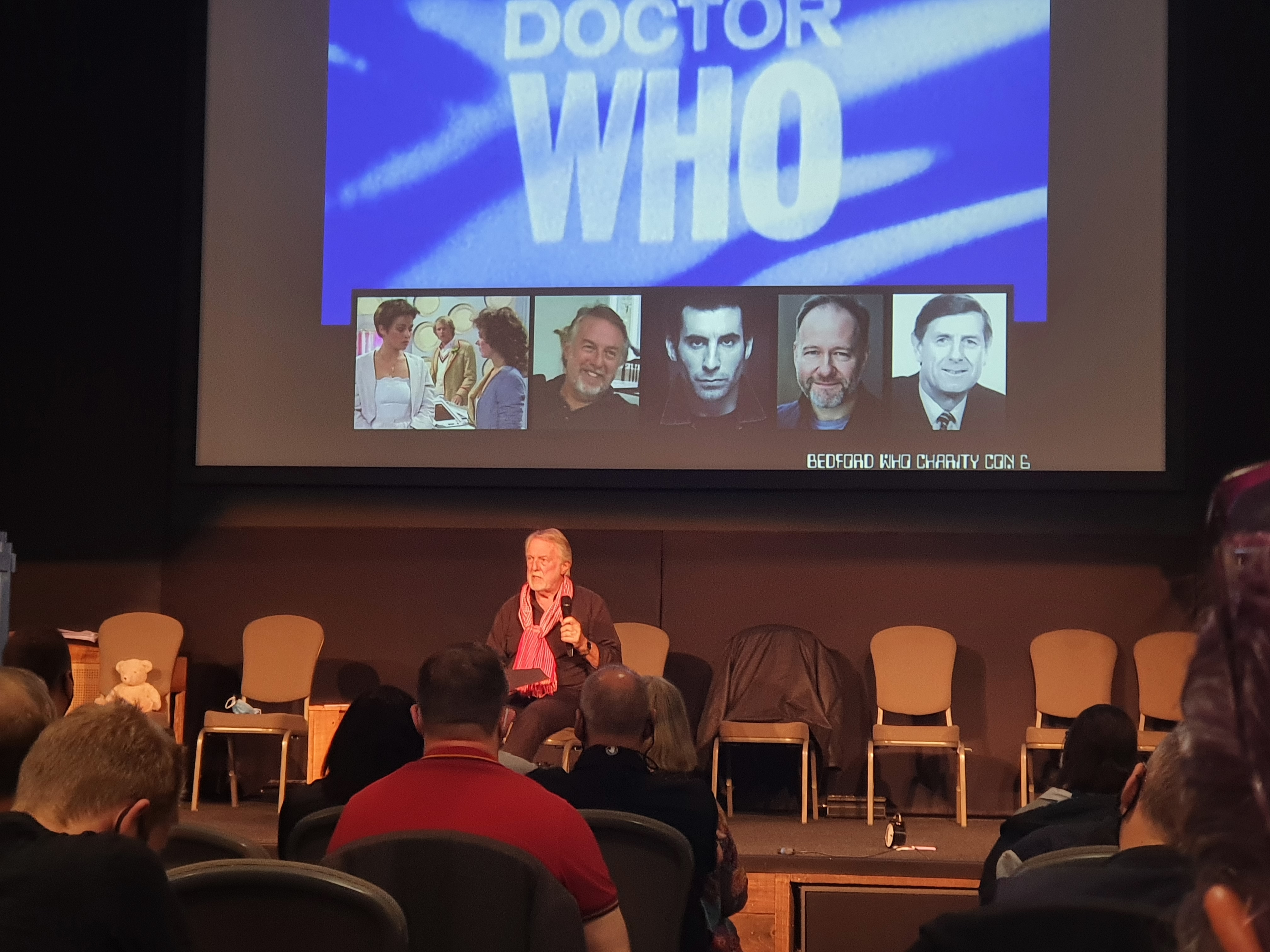
Image Description: Roger Murray-Leach sits with a microphone on stage in front of a projector screen.
Ian Bayley recounts the tale of a real world shaper.
Roger Murray-Leach is a man who doesn’t rest until things are just right. Taking to the stage at Bedford Who Charity Con, he preceded his talk by supervising the movement of props and the careful positioning of his chair as the stage was set. The notion that the audience were witnessing a metaphor for the set designer’s meticulous attention to detail in both planning and delivery was not lost on the attendees. Unlike the other guests, all of which were interviewed, Roger took control of his time at the convention by addressing the auditorium directly from 20 pages of his type-written notes.
He began by setting his era in the context of Doctor Who history, with Roger using the opportunity to express his loyalty to the team he worked with. Incoming producer Philip Hinchliffe was a “new broom” committed, with Robert Holmes’ help, to creating stories with “more depth” than before, and so when Philip left, so did Roger. Though the show is now nine Doctors later, Tom Baker remains his personal favourite. Describing him as both “eccentric” and “avuncular”, Roger argues that children always knew they were safe when the Fourth Doctor was in charge.
As set designer, Roger’s job was to support the crew and cast by working to “fulfil the director’s dream” and his first project was Space Station Nerva, which was due to serve in both The Ark in Space and Revenge of the Cybermen. His guiding philosophy is that sets work best when they leave something to the audience’s imagination, so he designed Nerva to “make sense”. This included giving the cryogenic repository, intended as a last bastion for the human race, a sense of scale appropriate for keeping as many humans on ice as possible. This was achieved through his erection of vertically stacked pallets to house the bodies which would be accessed using a lift, while the use of mirrors doubled what the audience could see. However, this philosophy was balanced by the practicalities of BBC productions in the 1970s. The seemingly endless corridors of the station were circular to fit the exterior model shots, but also ensured that the camera’s view was limited to the curve within its view; saving on additional fabrication. Roger also raised the floor to ensure that the painted linoleum look was not too obvious and to prevent the set from shaking while the heavy cameras were moved about.
Perhaps appropriately for a person who helped to turn the studio-bound Ark in Space into such an immediate and enduring success, all of Roger’s bad memories from his time on Doctor Who concerned his location shoots. He had to install Styre’s spherical spaceship for The Sontaran Experiment in the distant post-apocalyptic landscape of the Dartmoor tors while simultaneously setting up Space Station Nerva in Shephard’s Bush. While the set-up went as planned, it couldn’t account for the human factor, as Tom Baker fell and broke his collarbone. Such an accident was tragic enough already, but the production team also had to disappoint a horde of local schoolchildren eager to meet their new Doctor.
While the children were sent back, Roger followed Tom’s ambulance to Torbay hospital. Though he had to be back in London for the studio preparations, he cemented a friendship with Tom, who was afraid he would be recast, while they waited for his X-rays. Similarly, Revenge of the Cybermen was singled out as the story he wished had not been commissioned on – not only due to the claustrophobic atmosphere of Wookie Hole but also because of Elisabeth Sladen’s speedboat accident, in which she had to be rescued from drowning by Terry Walsh.
His next story was a welcome return to the studio as he designed Zeta Minor for Planet of Evil. His set was intended as a reaction against alien planets from other science fiction shows, which often consisted of ‘soulless’ open spaces with distant buildings in the background. This prompted the swampy tropical jungle produced for Planet of Evil with hanging creepers, red foliage and black pools that were meant to represent pools of literal nothingness. While the foliage for this story was straightforward, real-life plants presented a problem when putting together the greenhouse of Chase Manor for The Seeds of Doom, his next story. The sets had to be taken down and re-erected every week and dressed with plants from a local nursery. When the plants sent one week did not match the previous week’s, he spent nearly the whole night redressing the set so that it would look the same just in case retakes were needed.
A similarly stately set was needed for the panopticon in The Deadly Assassin. The requirement for a Roman senate-like structure initially stumped Roger but again he was able to achieve what he needed, this time with a lot of glass and acrylic paint. On a smaller scale, he also created the message that the Doctor left to warn of the assassination in a language now superseded by Circular Gallifreyan while also introducing the Seal of Rassilon that has since been used widely. This symbol can also be seen in High Council rooms of Voga, but for Roger, it is not just the reuse of an attractive design – they are meant to be the same symbol, indicating the presence of the Time Lords in Voga’s history.
Roger’s final story, The Talons of Weng Chiang, required the spirit of the Victorian period to be resurrected. In the studio, this required the sewers of London to be recreated, and Roger’s commitment to detail took him into actual sewers to inform his design. As well as finding out that the smell of sewers rises, leaving the lower portions relatively bearable, Roger found that the floor is narrow to encourage fast flow. This helped inform his design, which had to be waterproofed with fibreglass to allow running water to flow through it. However, this caused problems when the studio flooded after the engineers forgot to connect the water supply properly.
The issues continued outside of the studio, with location filming once again proving problematic. On discovering a perfectly preserved Victorian theatre in Northampton to use, he was instructed to find other usable locations in order to make a trip up there worthwhile. When he couldn’t find a Victorian hospital, only a Victorian morgue, the script was reverse engineered to fit as the filming deadlines approached.
While The Talons of Weng Chiang is a problematic story both on and off screen, it offered new opportunities for Roger when director David Maloney recruited him for Blake’s 7 where he designed not only the interior of the Liberator but the exterior as well.
While preparing for the show, he and David went to the cinema to watch Star Wars: A New Hope “to see what the competition was like” and they were both blown away by the opening shot of the Tantive IV, realising that audience demands for science-fiction were about to change. While films had huge budgets, television production was done “on a shoestring”, with the equivalent of just under £28,000 in today’s money for each episode. However, he argues that the era’s television remains a triumph of ingenuity, comparing it with Jamie Magnus Stone’s expedition to film Spyfall in South Africa which would have cost significantly more. He pondered if Doctor Who was a completely different show back then, less as an assertion and more as a philosophical quandary. While Skyfall may have had the budget, he argues that his episodes instead had the now-enviable freedom to experiment due to the ethos of public service broadcasting, and that the creativity this unleashed is perhaps the main reason why so many people watched and are still watching.
That was all we had time for in the April convention, with the meticulously planned review of Roger’s entire career stopping at the point in which he left Doctor Who for Blake’s 7. However, Simon Danes, the organiser, secured a promise from him that he would return to finish the story in October and so he did. Roger’s main contribution to Blake’s 7 was to design the set of the Liberator. The sleek design of the ship was mirrored in its construction, with Roger arranging for an outside contact who made bodies for racing cars to construct the pieces of the set from fibreglass. He was rightly proud of the result, and its iconic design featured in every series but the last. It continued even after Roger left the BBC after the first series, angry at how stagehands had mistreated the set when moving it.
After leaving the BBC, Roger made the difficult transition into film. While he would achieve a BAFTA nomination for his work on Winston Churchill: The Wilderness Years (1981), it was a baptism of fire. In addition to the use of over 400 sets and six months filming in the US and UK, he also had to fight hard to prove himself due to his TV background, which was seen as inferior to film. Similarly, his work as Art Director on The Killing Fields (1984), a film nominated for seven Oscars about an American journalist Sydney Schanberg in Cambodia, was also difficult but in a different way, as the production brought a harrowing story to life in difficult working conditions that made him want to go home. However, Roger received a reward for his perseverance when, at the premiere, Schanberg himself revealed that the film had helped him to connect with his son. His time on Local Hero (1983) brought him unknowingly into contact with the future of Doctor Who when a young Scottish actor called Peter Capaldi told him how much he envied him for having worked on the show.
Roger’s October talk was more interesting for its insight into his values, both personal and production, continuing the themes of his early talk. The script of a story, he explained, is like the base of a pyramid: many people have to work hard to build on top of it. Echoing his thoughts on Nerva Beacon, he said that sets need to feel lived-in so that the audience believes they have existed long before the scene begins. He illustrated this with the striking metaphor of “the half-eaten apple” that must always be visible. Unsurprisingly, therefore, historical accuracy is particularly important for Roger. Directors may think rough approximations are good enough but viewers will notice mistakes even in small details, be they anachronistic dialogue or table manners. Even if they don’t notice something consciously, they may still sense that something is off. However, this reasonable expectation from the viewer stands in contrast to the sneering he once recalled from a critic that his designs for the Liberator showed no knowledge of the mechanics of space flight. This was a preposterous charge, he felt, given that the notions of space travel are themselves based on fantasy.
Both halves of Roger’s talk were interesting, providing an insight into the often overlooked work of the set designer even if, paradoxically, their work is always on screen. Sets should be as much an extension of the characters who move around in them as the costumes clothing the actors, providing something to ponder when rewatching the many Hinchcliffe-era classics that have Roger Murray-Leach in the credits.
Print copies of Tides 49 are, at time of publication, available to buy through this link
 The Tides of Time