Image Credit: Big Finish (Fair Use)
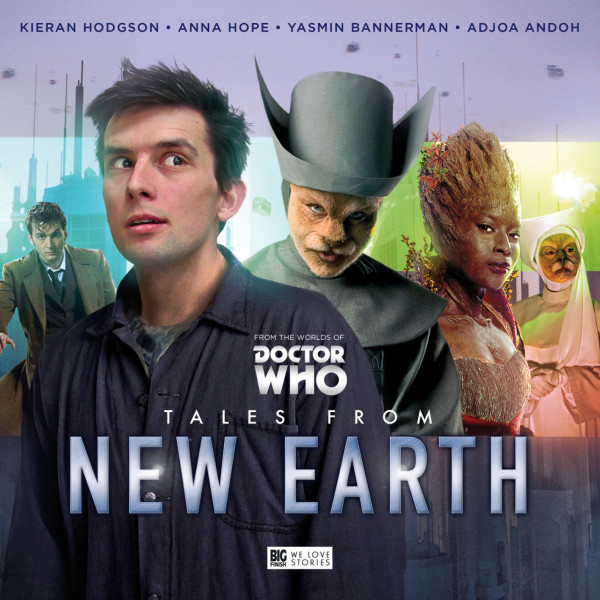
Image Description: The cover of Tales from New Earth
By James Ashworth
Back in 2006, Doctor Who visited New Earth for the first time. In some ways akin to the Classic Series’ Peladon, the planet provided the setting for two episodes while providing some commentary on our very own world. Aside from a few mentions, the world then disappeared, seemingly never to return. Ever keen to spot a continuity gap, Big Finish brought Doctor Who fans back to the planet in 2018 with its Tales from New Earth boxset. Weakly plotted, and with all manner of mixed messaging, it’s a release that is probably best avoided.
The boxset opens with Escape from New New York, a title that makes the story sound more interesting than it actually is. While Senator Hame investigates a series of mysterious disappearances, apprentice lift engineer Devon Pryce discovers that all is not well at Elevator Lodge. What should be a tight political thriller, however, descends into an unintentional farce. Perhaps the prime example is a scene where Senator Hame meets the Duke of Brooklyn to discuss the missing people. That the characters repeatedly use the word “ascended” to describe the missing people, and don’t immediately link it to elevators in a city full of them, is already a stretch, but the audio then compounds the ridiculousness of the situation. After Hame agrees to assist the Duke in the search, the very next scene with both these characters has the Duke reveal he’s managed to find an eyewitness, with Hame having apparently never left the building.
The Duke also represents a tonal conflict within the audio. In what is otherwise a story played relatively straight, this is a man who keeps otters – not otterkind, just otters – in his beard that he uses to spy on the city. If the audio existed in more of a heightened reality, this might make narrative sense, but as it is the character is a strange addition who promptly disappears afterward, never to be seen again. Meanwhile, Devon is not immune to some odd character choices. While it’s not required that a story’s lead be sympathetic, he acts as a bit of a jerk for a good proportion of the story, especially towards Thorn. While later stories will assert that Thorn is his boyfriend, a combination of lacklustre sound design and vague writing mean that’s never really made clear until he dies as a result of the Lux’s attempted takeover.
Speaking of the Lux, their use as the villains of not just this story, but the boxset, is an odd one. The most immediate issue is their name. Doctor Who fans are likely to recall the Lux family of Silence in the Library/Forest of the Dead, which these villains, and their company, have absolutely nothing to do with. As such, it’s strange why another name wasn’t chosen for these light-based adversaries. Their concept also leaves much to be desired. The plot of Escape from New New York boils down to the Lux trying to turn the population into themselves by using lifts as conversion units. Inevitably, this means that comparisons will be drawn with the Cybermen, and not particularly favourable ones. The Lux don’t have any of the aspects of body horror or cold logic that make the Cybermen compelling, but instead a pseudo-religious angle that never really entices. While the Lumen, the Lux’s metallic avatars, are specifically statuesque – a choice which could invite discussions of religious idolatry in the story – they also happen to look like smaller versions of the Statue of Liberty. This makes sense when a story is set in a version of New York. It doesn’t when the rest of the boxset travels further afield.
After saving New New York from the Lumen, Devon decides to head off to the New Forest to speak to Thorn’s family following his demise. Any emotional drama that could be wrung out of such a moment, however, is nixed as soon as Devon arrives and finds that they’ve all been gnawed to death. Could the Termitions, a race of termite people who live in patches of the New Forest and have a grudge against the trees for evicting them from most of their home, be responsible? Of course! While the story flirts a bit with the Lux, who the world has conveniently forgotten just tried to take over New New York, being responsible, it ultimately turns out that the Termitons are carrying out killings without their consent and so are the culprits after all. By portraying the Termitions, the New Forest’s indigenous inhabitants, as universally aggressive and untrustworthy, the story unintentionally sends out some very mixed messages about peoples being evicted from their ancestral home.
After failing to meet Thorn’s parents, Devon’s other attempts to be important to the plot of Death in the New Forest also go awry. This is mostly due to the arrival of the Tenth Doctor, who proceeds to become the story’s protagonist while Devon gets relegated to the role of secondary companion. While Kieron Hodgson does a good job at capturing this incarnation’s vocal mannerisms alongside his role as Devon, it does raise the question of why David Tennant himself doesn’t perform the role. After all, he was already working with Big Finish on the Tenth Doctor Adventures at this point. The Tenth Doctor doesn’t exactly cover himself in glory though, with the plot spontaneously resolving itself when the Lux decide to kill their former allies but let all of their enemies depart unharmed.
The Doctor also returns for the subsequent story, The Skies of New Earth, in case audiences were worried that Devon might get too much to do in his own boxset. Before the Time Lord’s arrival, however, Devon becomes involved with a group of environmental activists campaigning against the use of a giant space laser used to mine clouds. In perhaps the least subtle use of Chekhov’s Gun ever committed to audio, this laser is instrumental to both the Lux’s scheme to brainwash the residents of New Caelum, and their defeat.
It may not be subtle, but The Skies of New Earth does turn out to be the boxset’s best story, even if it’s still not a masterpiece. The plot is at least somewhat logical, even if its engagement with the story’s environmental themes evaporates once the Doctor arrives. It also creates the boxset’s best characters – the duo of Oscar McCloud and Berkhoff. The former is a solar bear, a species of photosynthetic bear who use jet packs to get around, while the latter is a former mining executive bent on destroying his partner’s habitat. The unlikely pairing are chalk and cheese but work well as characters as they infiltrate Berkhoff’s former employer, Cloudburst. It’s a shame that Berkhoff is unceremoniously killed in a confusing scene, but Oscar McCloud, complete with his own rock theme, lives to fight another day.
That day is The Cats of New Cairo, the conclusion of the boxset. Is it at last Devon’s time to shine in his own boxset? No! This is Hame’s story, seeing her return to her hometown at the request of the leader of all Catkind. Unfortunately, the Catkind live in a deeply misjudged portrayal of a generically middle Eastern country, complete with Anna Hope providing a dubious accent for a background character. Add in the hordes of native inhabitants, the Scorpionkind, who have no dialogue and are only out to kill, and it feels like a throwback to the worst of 1960s Doctor Who.
The only real saving grace of this story is Adjoa Andoh as Sister Jara, who, faced with a lacklustre script, does the only thing she can and plays the sinister cat as high camp. Jara isn’t very nice, but is a delight to listen to as she tries to scheme her way through the plot. She even gets to bump off James Dreyfus’s High Persian, which is another added bonus. While the cats get up to most of the plot, Devon spends most of his time either ineffectual or mind controlled, and isn’t a particular asset to the overall proceedings.
As a result, Tales from New Earth ends like it began – confused, not fully engaged with its premise, and full of baffling decisions. Why are the Lux the main villains, when existing Doctor Who characters already have that name but are unrelated to this story? Why are the stories all an hour long, when they don’t have enough plot? And given that David Tennant was performing as the Tenth Doctor for Big Finish at this point in time, why isn’t he in it? As it is, Anna Hope and Kieran Hodgson do sterling work trying to keep the boxset afloat, but unfortunately it all comes to naught. In some ways, these stories do have to be heard to be believed, but it’s also much easier to just save several hours by watching The Secret of Novice Hame again and pretending that these never existed.
Print copies of Tides 49 are, at time of publication, available to buy through this link
 The Tides of Time