Adam Kendrick reviews Oxford student production Sci-Fi Show, staged in November 2023, with additional thoughts by Lois Hannon.
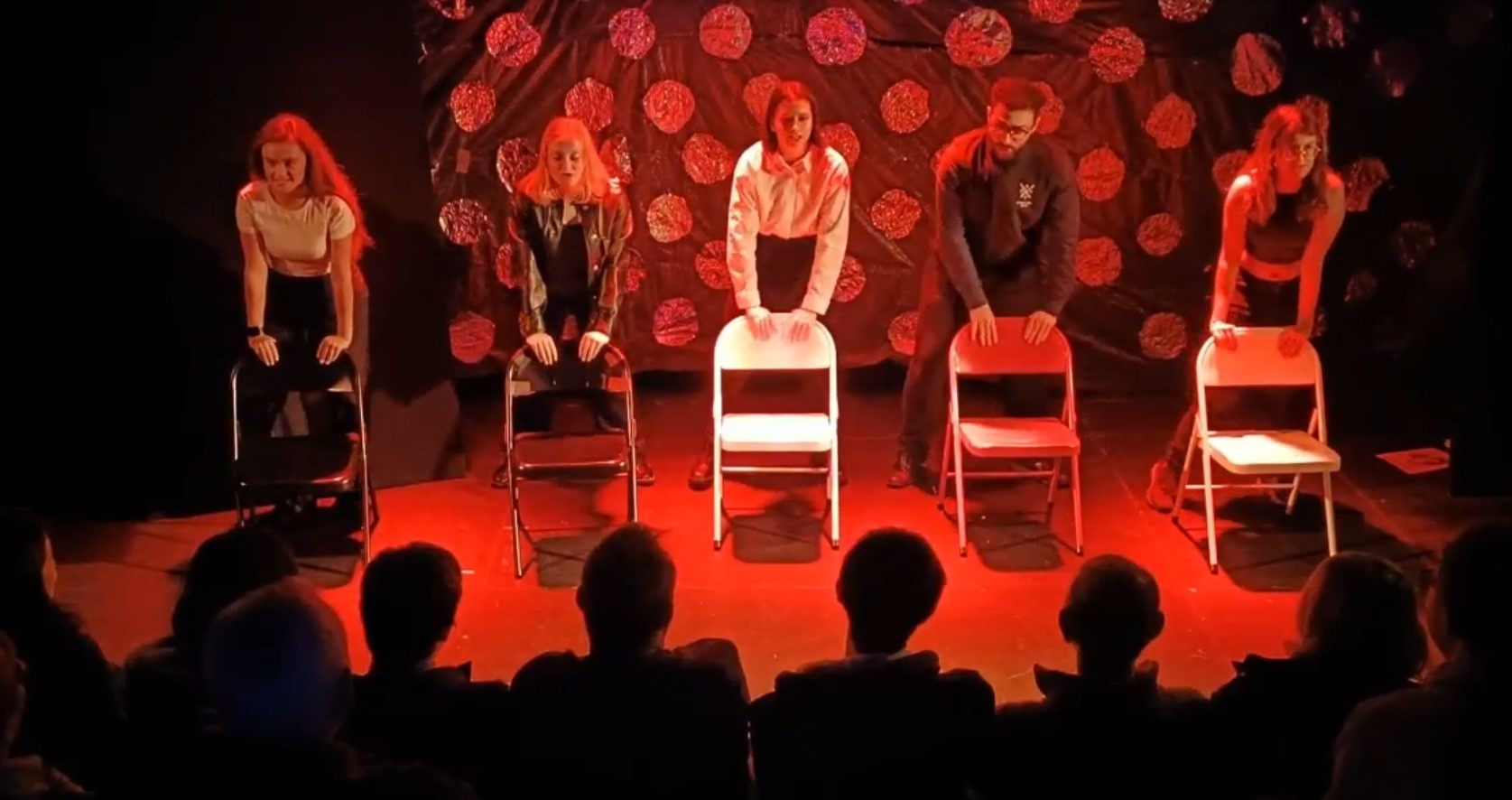
Back in November, you could hardly move for the sheer volume of Doctor Who-related content that was released during the 60th anniversary celebrations. Classic serials were uploaded to iPlayer, new documentaries were broadcast, various Big Finish audios became available for free on BBC Sounds, and if you happened to be in the Oxford area, you could have even seen a musical parody of Doctor Who at the Taylor Burton Studio! Written by Cassie Wicks, Sci-Fi Show was a timely celebration of this long-running cultural institution, performed by a talented cast of six members of Oxford University Dramatic Society between 14 November and 18 November.
The story concerns a disillusioned showrunner called John B. Stevens, who has agreed to write a fourth season of the recently revived and hugely successful science-fiction television show, Professor Where. Overburdened by the workload, creatively exhausted, and suffering from the perpetual wrath of a rabid fanbase that can never be satisfied, Stevens decides he’s had enough and vows to call it quits after one last series – only for a freak accident to transport him through realities and into the very same television show that he helped bring back! As someone used to dealing with the BBC’s upper management rather than bug-eyed aliens, Stevens becomes completely bewildered by the Professor’s madcap world of nonsensical technobabble, tinfoil-plated robots, and endless female companions as he desperately tries to stay alive and find a way back home.
Truthfully, this farcical plot was ultimately an excuse for everyone to make lots of silly jokes about Doctor Who. Many of these gags would have been familiar to long-term fans, from problems being conveniently solved by ‘reversing the polarity’, to Daleks suddenly being as inaccurate as Star Wars stormtroopers whenever they shoot at the main characters, to the Doctor’s concerning habit of picking up young women with an age gap in the thousands. Cassie Wicks managed to cram an impressive number of in-jokes from Doctor Who’s own continuity, ranging from Earthshock to Love & Monsters, although these explicit references to characters, organisations, and plotlines from Doctor Who did admittedly muddle the parody – after all, Sci-Fi Show was ostensibly about a fictional television show and any similarity to Doctor Who would surely have been coincidental.
The Professor is best described as a tall and lanky amalgamation of the Tenth, Eleventh, and Thirteenth Doctors, and thus dressed accordingly: their costume consisted of red trainers, a rainbow bowtie, glasses, and a long grey-blue overcoat resembling Jodie Whittaker’s. (During a very lengthy sequence where the Professor was repeatedly shot and regenerated into increasingly absurd incarnations, this coat was quickly passed along to the next member of the cast until they eventually regenerated back to their initial self.) Quirky and high-spirited, this eccentric extraterrestrial was ready to solve any problem with the help of their trusty sonic wrench. Instead of a TARDIS, this mysterious Space Lord travelled through time and space in a KX telephone box called the ‘Space-Hopping Interplanetary Temporal Engine’ – or SHITE for short (‘it’s pronounced shy-TEE!’).
Even though the humour was often childish (and as we all know, there’s no point in being grown up if you can’t be childish sometimes), it never became mean-spirited or spiteful, and a couple of jokes genuinely made me laugh out loud. For instance, we learnt that despite how the angst of ‘the Space War’ prevented the Professor from seriously considering a romantic relationship, they did nonetheless have a brief fling with Queen Elizabeth (no, not the Virgin Queen –the other Queen Elizabeth). Later, a leather-clad woman who initially claimed to be the Professor’s daughter was eventually revealed to be a vengeful ex-companion whom the Professor dropped off in 1831 with some bloke that she had only spoken to twice. Despite being ditched, she still held romantic feelings towards the Professor. Why would someone who loved the Professor pretend to be his daughter? ‘Well, it worked for Georgia Moffett.’
Since this was a student production, the shoestring budget was understandable and proudly on display, with every prop consisting of repurposed household objects: Daleks held plungers and whisks in their hands, a musical keyboard was used for the SHITE console, and a Bop It toy became the convenient plot device that transported Stevens across dimensions into fiction. Nearly every set was charmingly constructed from cardboard, with the SHITE interior being little more than a black backdrop adorned with ‘round things’ cut from tinfoil. Fortunately, having amateur production values can work in your favour when you’re sending up a television show which is notorious for historically having low budgets!
Did I mention that this was a musical? There were plenty of memorable tunes with the cast giving strong vocal performances and each main character receiving their own solo numbers. Highlights included a sultry tango where previous companions monologued about the misfortunes that befell them while travelling with the Professor, and a cheerful ditty about how there was absolutely nothing problematic about how most of the alien races that the Professor encountered, much like the Professor themselves, just so happened to be awfully British. And of course, there was a singing Dalek who wore a rather striking dress decorated with plastic spheres and garlic. The Daleks from Jubilee (Big Finish, 2003) can eat their tendrils out!
I’ve always believed that the best Doctor Who parodies are always the ones written by fans of the show, such as Steven Moffat’s The Curse of Fatal Death (1999) or the terrific The Lenny Henry Show sketch from 1985 where Lenny played the Doctor himself. I’m more than happy to rank Sci-Fi Show amongst these legendary spoofs; everyone involved with this production genuinely loves Doctor Who and understands why this show has lasted for more than six decades. It may have been incredibly daft and had a few technical hiccups (such as actors missing their cue or corpsing during the sillier musical numbers), but it remained an affectionate homage and was authentically sincere, particularly towards the ending when Stevens realised how important this wonderful TV show was to him and that he never wants it to stop. Considering that Stevens’s main inspiration, Russell T Davies, has since returned as showrunner, it seems that no matter what you might think, you’ll never truly be done with Doctor Who.
Lois Hannon’s thoughts
I really enjoyed Sci-Fi Show! It was haphazard, a little daft, and I could see where it was going from a mile away, but it was very funny with lots of semi-obscure references. The fourth wall bits with the audience were good and I want to give whoever came up with the parody of Chicago’s Cell Block Tango an award! What it had to say about the interrelation of fandom with the show itself was very interesting, especially how popular fandom critiques of the show were translated into direct challenges posed to the main characters. The twist that the story was actually about the ‘companion’ character the whole time was genius, and I really appreciated the choice to incorporate Whittaker’s coat into the Professor’s outfit, even though the producer, Aleks informed me that this was mainly because the director happened to have one on hand. It was a good time!
 The Tides of Time
[…] Adam Kendrick interviews Cassie Wicks, writer of Sci-Fi Show, a musical comedy that celebrates Doctor Who and will be materialising at this year’s Edinburgh Fringe Festival, following its debut run at the Taylor Burton Studio in Oxford. […]
LikeLike