Matthew Kilburn looks at the Oxford career of the late Barbara Clegg.
Barbara Clegg, who died on 7 January 2025, aged 98, is known to Doctor Who fans for her 1983 serial Enlightenment, which drew attention by stretching the conventions established by the middle of the Peter Davison period. Where Earthshock (1982) had struck a direction towards fast cutting and a sort of technological machismo, which the 1983 season had not fully digested but which cast an anaemic influence on Arc of Infinity and a more mythologically-plated one upon Terminus, Enlightenment unexpectedly stressed the experience of women and of men amidst the ‘other ranks’. Janet Fielding was given some more demanding material than often as Tegan, resisting objectification in the eyes of the Eternal Marriner; the principal villain of the story was an exemplar of one route to female empowerment in a man’s world, Lynda Baron’s Captain Wrack, who rejects conventional feminine virtues and seeks to outmanipulate through foul play her male-presenting Eternal rivals. Amidst beings who deny humans the freedom to choose, Enlightenment is the rediscovery and assertion of that right. In the midst of a Doctor Who increasingly seeking affirmation in past precedent, Enlightenment‘s reframing of the Black and White Guardians it inherited within the story’s own concerns felt curiously liberating.
Barbara Clegg is particularly of interest to this Oxford University-adjacent publication because she attended Lady Margaret Hall, Oxford, from 1944 to 1947, where she read English. She was one of the leading personalities in the student theatre scene as it found its feet after the Second World War. In the immediate aftermath of the war, women were excluded from being ‘idols’ of student magazine the Isis, but for a while eminent Oxford women student were profiled in a separate feature, ‘Have You Met–?’, suggesting people who it might be interesting or useful to know while avoiding the unfeminine attributions of ambition associated with the male Isis idols. (Shirley Catlin [later Williams] and Val Mitchison would eventually break the gender barrier and be profiled as Isis idols in 1950.)
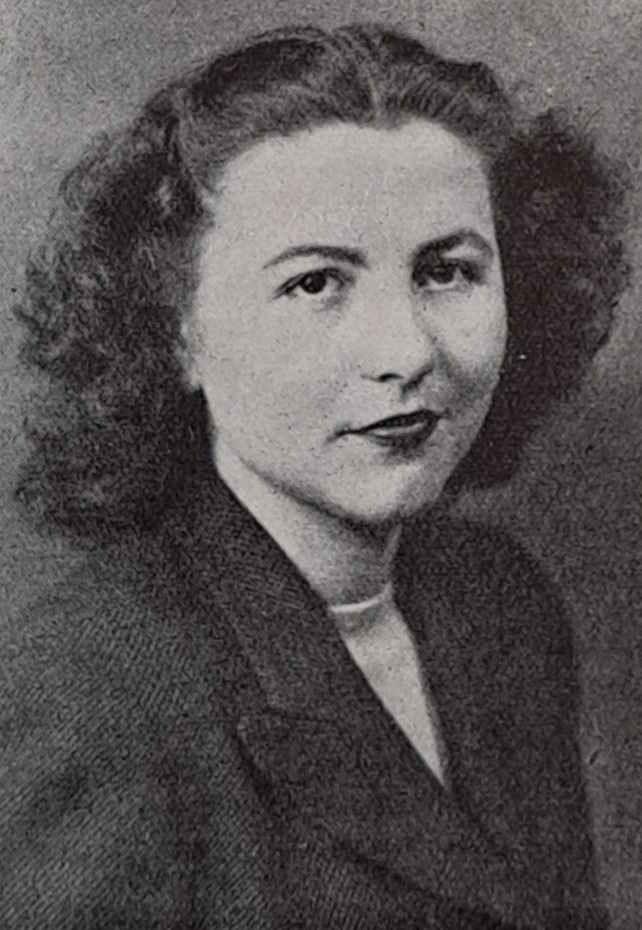
In the Isis of 8 May 1946, readers were asked whether they had met Barbara Clegg. She cut a distinct figure in mid-1940s Oxford, cycling ‘very upright’ on her ‘absurd little blue bike’, paid close attention – ‘really listening’ – in lectures, and had taken to wearing scarlet stockings and keeping goldfish. Readers learned that she liked Ucello’s painting ‘Hunt by Night’ in the Ashmolean, the poetry of Virgil, which she read beautifully, sentimental French songs, ice-cream, and the cakes at Oxford restaurant the Angel. Most of all, though, readers would know her as one of the principal forces in the Experimental Theatre Club. ‘She doesn’t merely want to act in the rather ineffectual way of many of us up here. She is not merely going to act, in some dimly realized future. She acts.’ The article mentioned two of her recent successes, as Alison in Thomas of Ercildoune by Roger Green (then Merton College’s deputy librarian, a few years from assuming the name by which he is best remembered for his collections of Arthurian and other legends for Puffin Books, Roger Lancelyn Green) or ‘the harder, more shaded part of the wife’ in Eugene O’Neill’s Beyond the Horizon. She had a maturity and a ‘cohesion’ which gave audiences confidence in student productions, and had also mastered the ‘financial intricacies’ of the ETC.
Barbara Clegg’s Oxford theatre career continued: she played Doris in Kenneth Tynan’s ETC acting competition entry, T. S. Eliot’s Sweeney Agonistes, in June 1946. Indeed, Tynan’s securing Clegg’s participation was seen by the Isis critic as a crucial element in Tynan’s success in winning the competition. In the final Isis of Trinity 1946 (19 June), columnist ‘Pintpot’ declared Barbara Clegg and Christina Hodgson the university’s best actresses; as for best actors, ‘we have none’. The same issue reviewed the ETC’s staging of the Tynan production of Sweeney Agonistes as one of its eighth week plays, crediting Carol Mullen and Barbara Clegg with the play’s ‘authoritative opening’.
Over the Christmas and New Year vacation of 1946/47, Barbara Clegg was a member of the touring student company, the Oxford Players, whose venues included Regent Street Polytechnic, St Paul’s Cathedral, St Mary’s Church, Warwick and Horspath parish church; they performed A Mystery for Christ’s Nativity, bringing together the Second Wakefield Shepherd’s Play and one of the East Anglian mystery cycle with carols. They travelled around the country in two small cars and a trailer. The company’s members, as identified by Isis, included future film directors Lindsay Anderson and Guy Brenton; but a report in the Stratford upon Avon Herald (20 December 1946) revealed that it also included Paul Johnstone, eventually deviser of The Sky at Night for BBC Television and later head of its archaeology and history unit, and Barbara Clegg’s future husband.
Barbara Clegg’s youthful activities were followed by her local newspapers at home. As a member of one of Merseyside’s most prominent families – her uncle was John Moores, founder of Littlewoods – she often appeared in the social columns of the Formby Times and occasionally of the Liverpool papers too. She was on the front page of the Formby Times on 2 September 1944, at a christening, as one of the godparents of her young cousin Simon Brierley-Jones. In summer 1946 the Formby Times celebrated a Liverpool paper reporting on Barbara’s membership of a student touring company, playing a ‘bad angel’ in a morality play, The Castle of Perseverance, visiting London, Bath, Barnstaple and Exeter; they also remarked that she was going to make acting her profession. While the Formby Times clearly regarded Barbara Clegg as a favoured daughter of the town, sometimes they could be too enthusiastic. On 5 October 1946 they had to apologise for reporting that Barbara had been married in Liverpool before going on honeymoon in Switzerland; only the visit to Switzerland was accurate. Reporting on her twenty-first birthday party in Oxford – where her brother John brought her a bottle of sherry – was probably less controversial (Liverpool Evening Express, 4 March 1947).
Barbara Clegg took finals in Trinity 1947; she was not involved in Tynan’s full-scale Samson Agonistes at St Mary’s that term. After a few months, she headed north to Dundee Rep, where her colleagues would include other future Doctor Who contributors, Graham Crowden and Peggy Mount. She moved to Liverpool Playhouse at the same time as Peggy Mount in 1950; more theatre and television would beckon. Oxford was a distant memory for Barbara Clegg when she wrote Enlightenment, but I do wonder whether the peculiar idealization of women sometimes seen in 1940s Oxford, full of young men with barely any experience of women, had an influence in the depiction of Marriner’s behaviour towards Tegan in the serial; perhaps the Eternals are all student actors co-opting a real world which they don’t understand for their own purposes.
I’ve been around Oxford myself for a long time, and it has a lot of ghosts: buildings, shops, institutions, people I knew and people I didn’t, contemporaries and those who came after me and before me. If when I next walk along the High, I glimpse a flash of blue as a bicycle shoots by, perhaps with a dash of scarlet and a sense of maturity, I will be glad to imagine that I have encountered the Oxford shade of Barbara Clegg.
 The Tides of Time
[…] the lack of activity here in recent months. I might write something about why. In the meantime, a link to an article I’ve written for the Oxford Doctor Who Society on the university career of […]
LikeLike