‘Tick tock goes the clock.’ Building a world in Series Six’s standalone horror story. By Charlie Bowden
‘Such a lovely old song, but is it about him?’
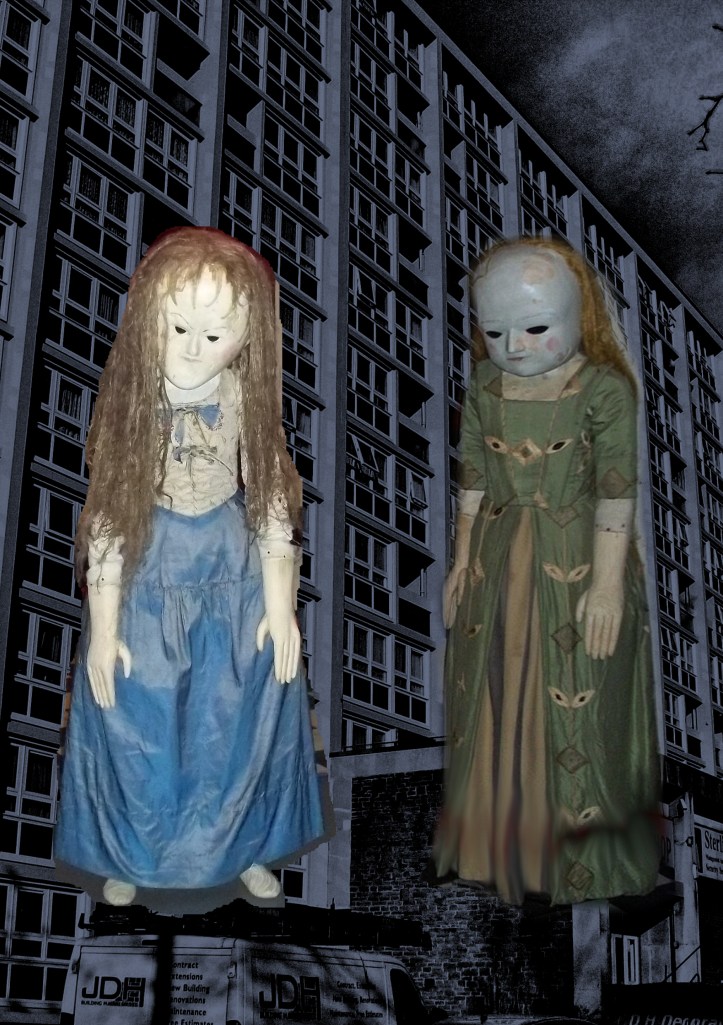
I remember being both creeped out and incredibly intrigued when I first sat down to watch the Series Six (2011) episode Night Terrors and heard Mark Gatiss’s prophetic nursery rhyme. The more I think about that time and the lyrical premonitions that were shoehorned into this otherwise standalone story, the less the song makes superficial sense. How could a set of peg dolls brought to life by a Tenza with seemingly no experience of the world outside the Rowbarton estate know a song detailing the relationship of the Doctor and River Song? Why did Steven Moffat, as was revealed in the instalment of Doctor Who Confidential which accompanied the episode, About a Boy, instruct Gatiss to communicate the Doctor’s impending demise through a melody meant for children? As with most things related to Doctor Who, there is no precise answer, but we can make some educated guesses about the intentions behind and in-universe context of this haunting set of rhymes.
And what things shall we see?
The straightforward narrative of the song is the relationship between the two central characters of Series Six: time passing differently between them; the Doctor meeting River as a baby; their impending marriage; and each watching the other die. The difficulty of reading between the lines here is that the nursery rhyme is never presented in full – even in Night Terrors itself the entire collection of verses is not revealed. The ‘agreed’ order is based upon the order in which the verses are heard on screen. This is arguably supported by Mark Gatiss, as on 4 September 2011, the day after Night Terrors was broadcast, Gatiss tweeted the four verses heard in his story, in the order which they were presented. However, uses of the rhyme in later episodes vary some of these words.
Perhaps this is already a sign that we’re barking up the wrong tree, that Gatiss and Moffat always intended this to be a throwaway scare tactic and plot device rather than a fully conceptualised piece of music. The production history of Night Terrors might play a role in this, since the episode was written for inclusion in the first half of Series Six, explaining the lack of discussion of later plot elements in the script. The originally-shot closing scene was replaced with one more appropriate to its new place in the series, and recurring appearances by Madame Kovarian were removed too.
And what now shall we play?
As explained in the episode’s Confidential, the rhyme only arose when Gatiss wrote a new closing scene for the episode, set in the TARDIS. It is, therefore, a last-minute addition to the story – ‘tacked-on’, as Sam McPherson of TV Overmind wrote upon its release. It is also worth noting here that the track ‘Tick Tock Round the Clock’ from the Series Six soundtrack is only an instrumental piece, foregoing the inclusion of any lyrics.
Not much can be made of the structure of the song’s rhymes either, with the first line of a couplet being either five or six syllables and the second being anywhere from five to seven. It’s notable that ‘you and I must die’ is the shortest ending to any of the couplets, given that it communicates the ultimate fates of the Doctor and River. Kovarian changes this to ‘your love will surely die’ in her utilisation of the song. All the couplets she utters end with a six-syllable line, suggesting a standardisation of metre that gives her words an additional threat. She also calls the song ‘old’, and indeed her scene with River in the 52nd century takes place long after the contemporary setting of Night Terrors. There’s still no definite indication of authorial intention, though.
She cradled and she rocked her?
Possessing fragments of the nursery rhyme in-universe doesn’t mean there’s nothing to be said about it beyond its obvious implications. One theory suggested by some fans, but not confirmed on the show, is that the rhyme acts as an ‘activation phrase’ of sorts to trigger River’s psychopathic training to take over. After all, at the end of Closing Time, Kovarian taunts River with the song and sings it to her as she is immobilised and placed into the Apollo spacesuit. On the other hand, when we are shown the Doctor’s death scene in The Wedding of River Song, River claims that ‘the suit’s in control’, suggesting that Kovarian would not need to make River wilfully carry out the murder if the machinery was designed to kill him regardless. Additionally, River is still able to resist Kovarian when the song is first sung to her in her office, and there is no visible transformation in her state of mind when it is repeated.
This idea ultimately hinges on aspects of the Kovarian chapter’s plan that were never shown on-screen – namely, their manipulation of River’s mind from childhood. It has been suggested that Kovarian might have sung the nursery rhyme to River when River was a small child, but there is no evidence to confirm this. If the song did hold such sway over her, why did Kovarian not try to use it to overturn River’s plans in the collapsing universe of the Series Six finale?
Doctor, brave and good
Before turning to a slightly more substantiated theory of the song’s origins, we need to consider its place within Night Terrors. George, the Tenza the adventure focuses on, has no known connection to the Silence or any of the events of the plot that spans the entirety of Series Six. When it first aired, Night Terrors was criticised for halting the forward momentum of A Good Man Goes to War and Let’s Kill Hitler, with the tick tock rhyme being the only element of the story that recurs later in Series Six. I find it very unlikely that the insertion of the song into George’s peg dolls was intended to insinuate that he was in some way connected with the Doctor’s death at Lake Silencio.
Instead, given that we know so little of the Tenza species in general, I suggest that George’s psychic powers and spaceborne origin enabled him to catch wind of the song before he hurtled to earth and assimilated into the lives of his parents. The rhyme seems to have a mythological quality, with even Kovarian not seeming to know definitely who the subject of the song is. It is quite plausible that the song circulated so widely that a Tenza heard it while moving amongst a variety of other species. Upon becoming George, he reached back into his subconscious when threatened by abandonment, thereby imbuing his personified fears with an ancient rhyme that coincidentally tied directly to the fate of the man who was helping him. Maybe the Doctor himself was even aware of the song beforehand and George pulled the rhyme from his mind to enlist his aid – though I doubt this as the Doctor didn’t hear the song before he was trapped in the dollhouse and didn’t seem to have a forceful reaction (or any reaction) upon hearing it.
And summer’s gone away
Based on the limited evidence we have, I’d conclude that the tick tock rhyme is an old song, perhaps even a prophetic one, about the relationship between the Doctor and the woman he would marry to face his own death. Given how time works within their relationship, however, I personally find it more likely that the knowledge of future events is drawn from the Doctor and River’s timelines being wibbly-wobbly. Both are, of course, time travellers, so either of them could have inadvertently inspired the song being written far in the past having already lived through what it foretold. Regardless, the rhyme was pervasive enough for a Tenza to pick up on it and insert it into his land of fear when being threatened with abandonment by the words of his father. George’s peg dolls co-opt the rhyme not as a message for the Doctor but because it was part of his subconscious psychic knowledge. Gatiss and Moffat certainly intended that the rhyme should overtly tease the impending end of Series Six, but they neglected to offer much worldbuilding around the song. Nevertheless, it can still fit into the scheme of the Doctor and River’s ill-fated relationship, which goes so much further than anything a simple seven-stanza rhyme can state.
References
Mark Gatiss’s four Tweets of 4 September 2011, in order:
twitter.com/Markgatiss/status/110416235589681152
twitter.com/Markgatiss/status/110416391223521281
twitter.com/Markgatiss/status/110416570781667328
twitter.com/Markgatiss/status/110416962156363776
Morgan Jeffrey, ‘Mark Gatiss teases ‘Doctor Who’ episode’, Digital Spy, 12 April 2011, www.digitalspy.com/tv/cult/a314124/mark-gatiss-teases-doctor-who-episode/
Sam McPherson, ‘Doctor Who Episode 6.09 “Night Terrors” Review’, TV Overmind, 4 September 2011, tvovermind.com/doctor-episode-609-night-terrors-review/,
Georgia, ‘Doctor Who – Tick Tock FULL Nursery Rhyme’, YouTube, 7 October 2011, youtu.be/l08b6wofyA0?si=uPmrJkuBW21Mi3K1
This article also appears in number 50 of The Tides of Time, which is available to purchase in print or as a free download.
 The Tides of Time