Adam Kendrick provides his thoughts on the latest Doctor Who spinoff, The War Between the Land and the Sea.
The War Between the Land and the Sea (henceforth referred to as The War Between… for brevity, despite some creative but unpublishable suggestions made by certain sections of the Internet) wasn’t just the first televised Doctor Who spinoff since 2016; it also represents the swansong for the BBC’s partnership with Disney, which started with the 60th anniversary specials in November 2023 and lasted for a little more than two years. The initial announcement was met with both cautious optimism and scepticism, with some fans intrigued by the grittier tone, and others wondering whether a spinoff about UNIT dealing with Sea Devils could achieve more than retreading the same ground as Doctor Who and the Silurians (1970). Some fans directly questioned the introduction of a “sexy” female Sea Devil and the writers’ capability to explore a political conflict with nuance, while the more cynical suggested that the only reason for this spinoff’s existence was to deliver the remaining five of the 26 episodes commissioned by Disney, allowing Bad Wolf Productions to keep themselves busy as they waited for their benefactors’ decision regarding the future of Doctor Who. Much to their credit, the BBC remained fully committed to this spinoff even after it was announced that Disney had no plans to renew their partnership: indeed, a decision was made to bring the UK broadcast forward from early 2026 to the Christmas period (undermining its international release on Disney+ in one fell swoop) and continuing to heavily promote the show in between programmes throughout December, even after the final episode had been aired.
There’s an admirable dedication in how The War Between… takes a conceptually absurd premise about fish people walking out of the ocean and taking a stand against humanity, proceeds to splash a large production budget, and has everyone involved with the show taking it as seriously as Shakespeare. The tone is notably more grave than in recent series of Doctor Who, which might appeal to those who feel that Russell’s second tenure as showrunner had become too silly. Cameos from Trinity Wells (Lachele Carl’s recurring American newsreader who has appeared in every Doctor Who spinoff except Class) and the leader of the Albion Party (the nationalist political party introduced in 73 Yards) helps to connect The War Between… to its mainline show beyond occasionally namedropping the Doctor to highlight his absence. Having more episodes to tell its story allows for a slower pacing compared to most New Who episodes, with more time for tensions to gradually build and main characters to fully develop. Structurally, there’s strong similarities with Torchwood: Children of Earth (2009), a previous five-episode serial about humanity dealing with the unreasonable demands of an alien threat without the Doctor’s involvement: Colin McFarlane reprises his role as General Austin Pierce, most diplomatic discussions take place adjacent to a large glass tank, and unrepentant political leaders weaponise the international crisis for their own benefit. Thankfully, Aquakind are considerably less monstrous than the 456 and The War Between… remained suitable enough for any kids who wanted to stay up and watch it on a school night.
Another similarity with Children of Earth is the willingness to kill off its supporting characters, with even Kate’s own life being placed on the line. The Deep’s enjoyably tense descent into the Romanche Trench opens with the surprise introduction of multiple supporting characters, accompanied with some major death flags; as soon as the crew starts talking about how they’ll return as heroes and their plans for the future, it becomes immediately obvious that not all of them will make it back alive. (Incidentally, here’s a tip for any readers who might be planning a potentially fatal trip to the bottom of the ocean: if you have an estranged brother whom you haven’t spoken to in twenty years, maybe call him first.) The same episode also kills off Colonel Ibrahim, who perfectly fits the mould of fridged characters: he’s a conventionally-attractive love interest who periodically offers coffee and comfort towards the main character, while offering very little insight into his own personal life and personality. What’s unusual is that unlike most cases of minor characters being killed off for the sake of drama and character motivation, the roles are reversed and it’s the woman who survives. Jemma Redgrave absolutely smashes it as she portrays Kate’s grief and despair at losing her workplace lover, whose demise acts as the catalyst for this character’s slow unravelling as her façade of professionalism and cold detachment slowly crumbles.
However, the nature of being a Doctor Who spinoff can be detrimental. The War Between.. exists in a weird limbo where the show is supposed to feel more “serious” than Doctor Who, as reflected by how it aired during the Sunday evening drama slot on BBC One, yet it can’t become too dark or violent, be more than mildly suggestive when it comes to sexual content, or allow anyone to use strong profanity. Furthermore, since the Doctor ostensibly needs a present-day status quo that they can return to once they’ve finished regenerating into Billie Piper, it was a foregone conclusion that the humans would end up coming out on top in the conflict and the Sea Devils would be forced to return to hibernation. Much like whenever there’s a worldwide crisis in real life, everything returns to business as usual and everyone pretends that none of it ever happened. Conversely, had the war ended with the Sea Devils successfully wiping out the humans or even managing to reach a compromise (perhaps revealing that we had been witnessing events which took place in an alternative timeline), I would have no option but to admire the sheer audacity of it.
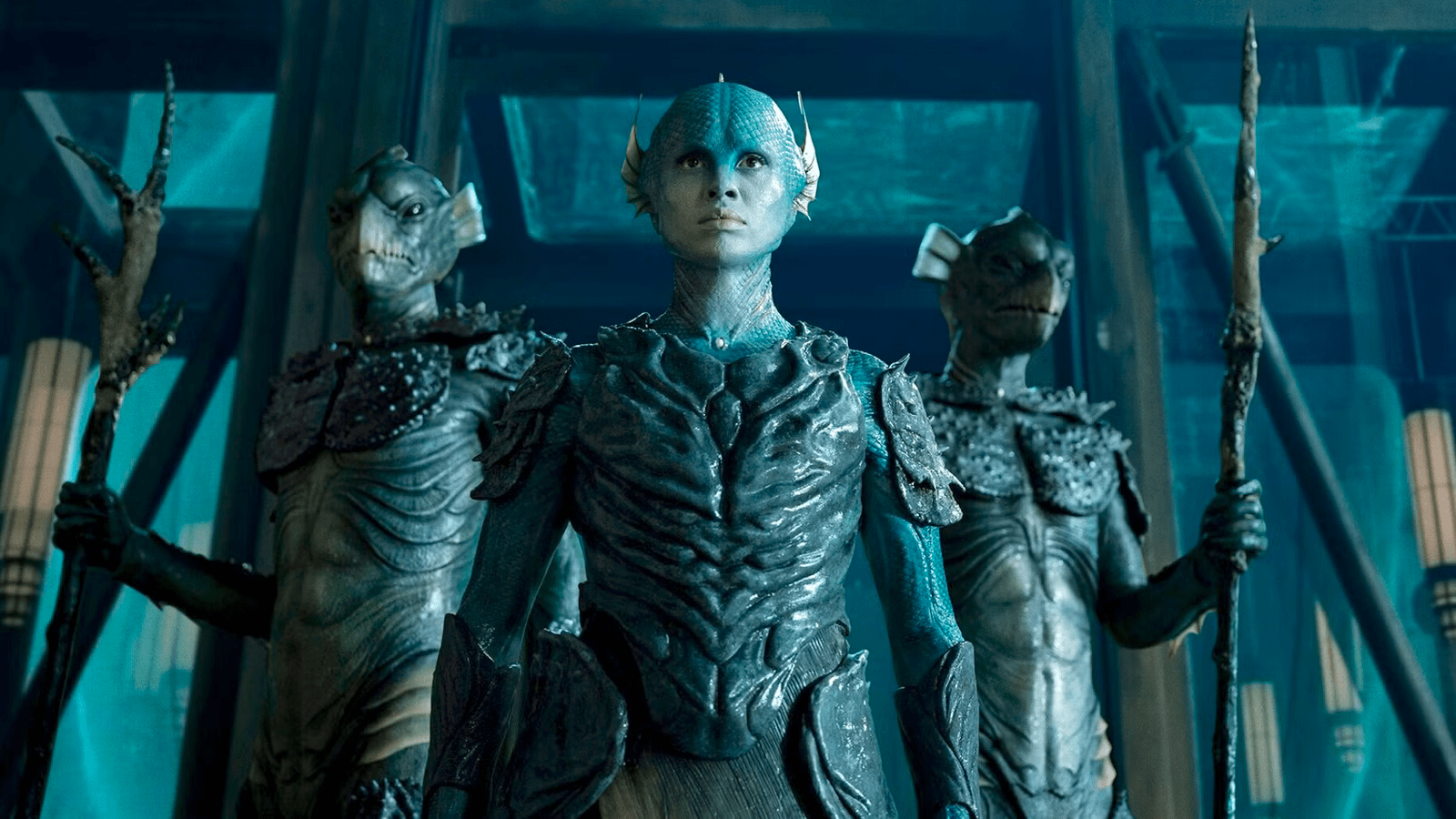
The Sea Devils themselves received an updated design which remained faithful to their previous appearances. Contrary to what some fans predicted when news of the spinoff leaked, these costumes were not simply recycled from Legend of the Sea Devils – in fact, Russell T Davies would later reveal while appearing on The Whoniverse Show that he had started drafting The War Between… five days before learning that Chris Chibnall was writing his own Sea Devil script (which he was forbidden from reading). The Sea Devils also acquired some new terminology (“Homo Aqua” and “Homo Amphibia”), leading to some early discourse over how Russell T Davies had apparently decided that fans weren’t allowed to say “Sea Devil” any more “because of woke”. This manufactured outrage became even more trivial in hindsight when it became clear that the term “Homo Aqua” had been coined in-universe on the spot by General Pierce (who notably gets the terminology wrong but refuses to let himself be corrected). In any case, a separate term was necessary to better distinguish the more traditional Sea Devils from Salt’s more humanlike appearance. Finally, these aquatic creatures were armed with a new range of abilities, from communicating with calcium carbonate pearls embedded in their necks, being able to change gender presentation, to having a control over water itself that allows them to rapidly accelerate rusting. Unfortunately, most of these ideas were dropped as swiftly as they were introduced or left as unexplained mysteries to punish humanity for their ferociousness. Even the so-called “Plastic Apocalypse”, in which dozens of major cities were bombarded with plastic waste, seems to have been cleaned up within two episodes (which really makes you consider whether five years would be plenty of time to sort out the planet if our governments acted this quickly).
Perhaps the biggest problem with The War Between… is how it remains unclear what the main focus was supposed to be. Is it meant to be an environmental parable, in which Planet Earth’s vengeful ambassadors inflict karmic revenge upon us for not recycling our plastic and keeping our rivers free of untreated sewage? Is it about the tragedy of colonialism, in which western civilisation makes contact with a new indigenous culture, makes plans to plunder their technology and knowledge, and subsequently wipes them out? Is it a geopolitical thriller about how governments and corporations will always conspire to eliminate any possibility of social change and maintain the status quo at the expense of billions? Or is this meant to be a simple Romeo-and-Juliet romance between star-crossed lovers from two different species in conflict, with Barclay abandoning his humanity so he can recreate The Shape of Water’s ending? The answer appears to be all of the above, regardless of any contradictions that could arise between these disparate ideas.
This clash in messaging might have arisen from the decision to split writing duties between Russell T Davies and Pete McTighe, whose previous episodes included a different kind of plastic apocalypse in Praxeus (2020). Whereas Davies seemed eager to tell a morally-grey conflict where both sides are at fault, McTighe’s three middle episodes are characterised by an urgency to take environmental action, aiming clear swipes at systemic problems such as unaccountable water companies and emphasising the establishment’s indifference towards those most affected by industrial pollution. However, Davies’ eagerness to raise the story’s tensions and call out humanity’s hypocrisy undermines any sympathy which McTighe had built up for the Sea Devils. The final episode, The End of the War, opens with the “savage”-coded Sea Devils kidnapping and eating pet dogs, invoking the same centuries-old racist trope about immigrants which was heavily spread by far-right hate groups and Republican politicians during the 2024 US Presidential campaign (during which filming for The War Between… took place concurrently). Later scenes show Homo Aqua accelerating the melting of the ice caps (despite how the subsequent release of trapped carbon dioxide into the atmosphere would contribute towards ocean acidification, something which would not be in Aquakind’s best interest), followed by an hostile Ambassador Tide threatening genocide, describing humanity as “dirt” that “will be cleansed”. This escalation allows for their brutal extermination to be justified on a selfish “it was either us or them” basis.
Although it’s important to consider the perspective of the Sea Devils, who have been choking on poison for centuries and believe that the humans arrogantly bombed their own peace conference, the truth is that The War Between… is presented almost exclusively from the human point of view. There’s no cutaways to underwater scenes where we listen in on what the Sea Devils are planning, learn about factions between Aquakind, or directly witness them suffering the impact of industrial pollution and biological warfare – at most, we pay a visit to their underwater palace, which gets destroyed before any diplomacy can begin. Furthermore, the story has exactly two named members of Aquakind – Salt and Tides – and only one of them can be considered to be “good”. Whereas in Doctor Who and the Silurians, we feel sorrow when the Silurians are collectively punished for the sins of one rogue Silurian, there’s little to suggest that the rest of Aquakind are as sympathetic as the anthropomorphic Salt. For their part, they’re either standing around menacingly or getting wiped out offscreen.
If there’s one consistent throughline in The War Between…, it’s the romantic subplot between Barclay and Salt, which slowly takes precedence over the geopolitical aspects. Russell Tovey shines as Barclay, an everyman who feels out of his depth after an administrative mistake pushes him into the spotlight, but whose sweetness and sense of empathy contrasts him against the insincerity and hollowness of politicians. Gugu Mbatha-Raw also impresses as the strong-willed ambassador, even though her jubilance after being relieved from the restraints of her society while on the run with Barclay feels too out-of-character. The performances from the leads carry the entire spinoff, although it’s questionable whether Barclay leaving his family to start a new life under the sea constitutes a happy ending, especially since millions of Salt’s fellow people had been exterminated by the equivalent of smallpox, which Barclay may have unintentionally spread to Aquakind with a kiss. This tonal dissonance echoes the ending of The Vanquishers (2021), when Karvanista headed off with Bel and Vinder for more adventures shortly after becoming the last of his race.
The song which plays over the final episode’s closing minutes – a slow, breathy cover of David Bowie’s “Heroes” performed by Alison Goldfrapp and Balfe – was presumably chosen because of its familiarity to the audience and how its subject matter felt suitable for Barclay and Salt’s situation: two lovers from opposite sides of a conflict face moral peril together (“the guns shot above our heads”) while yearning for freedom (“I wish you could swim / Like the dolphins, like dolphins can swim”). And despite knowing that their relationship may ultimately be doomed, they decide to stay together in the short-term (“Though nothing will keep us together / We could steal time just for one day”). This sense of irony in being “heroes” can also be applied to UNIT, with General Pierce partially quoting the lyrics in his motivational speech before he embarks on his one-way trip to Davy Jones’ locker.
There is a sense that The War Between… could have culminated towards a denouncement of UNIT as an institution on the basis that this militaristic and unaccountable intelligence agency ultimately fails in their mission without the Doctor’s assistance: by the time UNIT finally realises what Severance actually entails, it’s already too late for their Accord signal to make any difference. Much like with McTighe’s previous Doctor-lite outing, Lucky Day, UNIT’s status as the de facto good guys allows them to escape condemnation regardless of their failings and abuse of power, something which extends to the extrajudicial killing of Ibrahim’s assassin. Similarly, Kate repeatedly abuses UNIT’s surveillance capabilities for personal gain and blackmail purposes, is fully prepared to order UNIT troops to open fire on British soldiers, and threatens to shoot a civilian for the petty crime of public littering. And yet, despite pushing this former head of scientific research towards breaking point, there’s no guarantee that there’ll be a follow-up on this character thread any time soon unless UNIT is somehow involved in this year’s Christmas special. At the very least, it might be mentioned that their commander-in-chief had recently stepped down due to stress.
It’s already a common joke that the very last scene of the Disney era can be reinterpreted with a metatextual subtext, in which the show itself yells at their soon-to-be-former co-production partner to “Pick it up!” for a third series. Personally, I would go even further and suggest that much like how the Sea Devils are all but wiped out by Severance, Doctor Who itself is in danger of losing out to competing streaming shows such as Severance. Today’s television landscape is almost unrecognisable compared to the late 2000s and early 2010s, back when Doctor Who’s main competition was whatever ITV had scheduled simultaneously for Saturday evening. Unless the BBC can find a replacement source of funding, it’s unclear how the main show will be able to compete with the high standards and budgets of major streaming platforms without Disney’s support, let alone continue making more spinoffs belonging to the much-heralded Whoniverse.
 The Tides of Time