
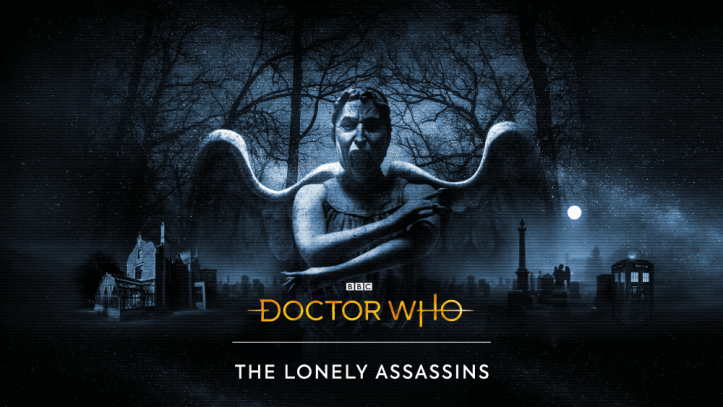
Image Credit: Maze Theory/BBC Studios (Fair Use).
Image Description: A promotional image depicting a Weeping Angel for The Lonely Assassins.
Adam Kendrick teams up with a cast of Who characters in his review of The Lonely Assassins. Warning – spoilers ahead!
Over the last couple of years, Maze Theory have developed and published three video games based on Doctor Who, some of which have been reviewed in previous issues of The Tides of Time. Other members have already covered Doctor Who: The Runaway and its sequel, Doctor Who: The Edge of Time, both of which were released for VR. However, I couldn’t help but notice that their mobile game, Doctor Who: The Lonely Assassins had slipped past this fanzine’s radar. In fact, I’m rather surprised at the relative lack of attention that this game has received from the wider fandom, because I genuinely think it’s one of the best Doctor Who video games ever made.
The Lonely Assassins was released in March 2021 and acts as an official sequel to the fan-favourite episode, Blink. Taking place 14 years afterwards, the premise is that you have somehow discovered a mobile phone belonging to Lawrence “Larry” Nightingale. Petronella Osgood from UNIT has helpfully hacked into this device and informs you that a few days ago, its owner mysteriously vanished without a trace. Your task is to help with Osgood’s investigation by rummaging through Larry’s photos, messages, emails, and browsing history for any clues to his disappearance, which you’ll then send over to Osgood. Most of Larry’s files will be inaccessible at first, but once Osgood has received enough data fragments, she can gradually recover and unlock more missing files for you. As you dive into the mystery, it becomes clear that a malevolent presence has been lurking in a certain abandoned mansion called Wester Drumlins and is about to be unleashed once again…
As such, this game fits into the recently established “found phone” genre, where the narrative is told entirely through an intuitive mobile interface, though it’s also available on PC and modern consoles if you’d prefer a larger screen. Whenever you find anything relevant to the case, you will be automatically prompted to scan it, which progresses the story. Although this does eliminate the legwork of being a detective, there are a few trickier puzzles for which you might need a pencil and some paper. For instance, you’ll submit a specific character’s personal details into a missing persons database and even commit identity theft (or “identity borrowing”, as Osgood prefers to think of it) to obtain a crucial file through social engineering. Thanks to some excellent writing, you’ll eventually construct a picture of Larry’s personal life and quickly care about what happened to him.
Aside from snooping through private messages and emails, you’ll also come across audio recordings and video calls (all of which are fully subtitled). Remarkably, both Finlay Robertson and Ingrid Oliver reprise their respective roles as Larry and Osgood, but there’s also a great supporting performance from Sabina Arthur as Larry’s significant other, Natasha. The best secondary character, however, has to be the bad-tempered Mr. Flint, an intimidating Welshman played by Ceri Mears who would very much like Larry to cease contacting him with urgent warnings regarding his latest property acquisition (guess which building he’s planning to renovate). And while The Lonely Assassins is a “Doctor-lite” serial much like its predecessor, there might be a surprise cameo waiting for you right before the credits roll…
Osgood herself acts as your guide and mainly communicates through the messaging app, where she discusses her thoughts and suggests what to do next, as well as being optimistic and generally likeable. Your replies are typically restricted to two or three possible responses, but each choice provides enough variety by letting you choose between being enthusiastic, uncertain, or sarcastic. You can also send Osgood any sightings of a certain blue box that you might stumble upon, which leads to some lovely conversations about the strange time-travelling alien she’s obsessed with. Best of all, you’re even allowed to ask her “Sorry, doctor… who?”
One minor problem with The Lonely Assassins is how, since the involvement of Weeping Angels is incredibly obvious (this game is literally named after them, after all), you will invariably know more about what’s really going on than either Osgood or your own in-universe character. Occasionally, I found myself shouting “It’s Weeping Angels!” at the screen while waiting for both of them to slowly work out what I already knew. Nevertheless, these terrifying monsters cast a looming presence over the entire experience and the moment when they finally reveal themselves to the player is when everything starts kicking off: your phone becomes infected by a Weeping Angel, resulting in a tense sequence where you need to track down and delete the corruption before it can escape – all while the interface deliberately malfunctions and becomes increasingly glitchy. It’s a terrific portrayal of these monsters that utilises their terrifying virus-like nature and prevents the player from feeling too comfortable.
Any Doctor Who serial worth its salt needs to be both equally scary and humorous, and this game succeeds in both aspects. There are a couple of well-telegraphed jumpscares, such as Angels suddenly appearing on your screen or sinister phone calls out of the blue, but the moments where you’re reading through Larry’s message exchanges, only for one of the participants to abruptly fall silent, bring their own disquiet. At the same time, the writing is incredibly witty and provides a lighter contrast to the horror of what’s happening – the sardonic response which Larry sent to an obnoxious customer’s complaint is particularly hilarious. The writers are clearly passionate fans of Doctor Who, because this game is absolutely crammed with continuity references from recent episodes such as Rosa and Vincent and the Doctor to more obscure media such as The Ultimate Adventure and Paul Leonard’s novel Speed of Flight. Characters from The Sarah Jane Adventures briefly show up and there’s even a fantastic joke about conspiracy theorists dismissing a TARDIS sighting as a mere prop on the grounds that “the windows are wrong”.
Essentially, this is a brilliant and lovingly crafted immersive experience which feels like an interactive episode of Doctor Who. The story is well-paced and gripping, with heartfelt moments and a tense atmosphere that slowly builds until it reaches a quirky-yet-satisfying resolution, followed by a wonderful emotional payoff. If you’ve ever wondered what happened to Sally Sparrow and Larry Nightingale after they defeated the Angels in Wester Drumlins, or just really love Petronella Osgood, you absolutely should play this. It only takes two or three hours to finish, it’s cheaper than buying a Classic-era serial on DVD, and following the recent closure of Time Fracture, it’s the closest you’ll get to being in Doctor Who for yourself.
 The Tides of Time