
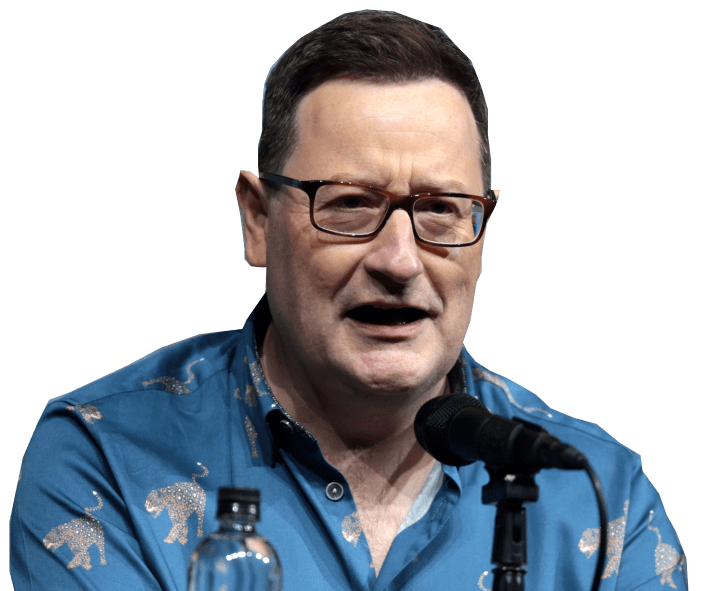
Image Credit: Adapted from Gage Skidmore (CC BY-SA 2.0, Flickr)
Image Description: Chris Chibnall speaks into a microphone
Adam Kendrick takes a look back at Chris Chibnall’s highs and lows during the showrunner’s time in charge of the TARDIS
With the torch passing from one showrunner to the next, the cycle of Doctor Who repeats once more. Following the broadcast of Jodie Whittaker’s regeneration story, Chris Chibnall has moved onto pastures new, leaving fans eagerly awaiting the 60th anniversary special, the return of David Tennant, and the arrival of Ncuti Gatwa’s Doctor. No doubt some fans are already treating the Chibnall era as a transitional period before the show is undoubtedly ‘restored’ to its former glory by Russell T Davies; the televisual equivalent of keeping the car running until the driver nips back from the newsagents. They might point towards declining overnight figures, pretending a direct correlation exists between popularity and quality, while ignoring the decline in live television viewing and the rise of streaming platforms in recent years. Indeed, these were in decline even before the Chibnall era, as Peter Capaldi’s final series also had the show’s lowest ever viewing figures at the time. However, to write off the past five years as inconsequential would be considerably, perhaps intentionally, dismissive of the successes achieved during Chibnall’s tenure.
Jodie Whittaker will forever be remembered as the first woman to officially play the Doctor. A self-proclaimed “Doctor of Hope”, her character was driven by optimism and her enthusiasm for both science and spiritualism as she clashed with religious fanatics across three finales in a row. Much like Peter Davison’s Fifth Doctor, she views herself as a mere traveller and pacifist, yet becomes compelled to intervene when faced with insurmountable odds. Whittaker deserves to be commended for portraying this legendary icon under intense pressure and scrutiny from the fanbase (often being held to greater levels of accountability than real-life politicians, let alone her predecessors in the role) and her performance grew stronger and more confident with every series.
Chris Chibnall, meanwhile, should be celebrated for not just casting the first female Doctor, but for pushing for diverse representation: the fact that the earliest known incarnation of the Doctor is now officially a black woman can only be viewed as a statement of intent. While Steven Moffat’s tenure argued that anyone can be the Doctor, Chibnall firmly established that the Doctor can be anyone, regardless of gender or race. Tosin Cole’s Ryan Sinclair was not only the first black male companion since Mickey Smith, but also a representation of someone with dyspraxia who refuses to be defined by his disability. Mandip Gill became the first long-term Asian companion, and we even had the first British South Asian Master played by the brilliant Sacha Dhawan. He performed the character as highly volatile and dangerous, yet deeply insecure and seeking vindication.
Series Eleven and Twelve featured the first four-person TARDIS team since the Peter Davison era, with Graham, Ryan, Yaz and the Doctor forming an incredibly likeable family unit. Bradley Walsh provided plenty of comic relief over two series, but also plumbed emotional depths as Graham came to terms with grief over the sudden death of his wife Grace. It was simply wonderful to watch the grandparental relationship between him and Ryan develop as they bonded over their adventures, with Ryan finally accepting him as his granddad. Meanwhile, Yaz began aspiring to greater heights than dealing with petty parking disputes and gradually became attached to the Doctor first as an inspiring role-model, and later as her unrequited crush. In Series Thirteen, John Bishop quickly became a fan-favourite as Dan, thanks to his charming personality, cracking dialogue, and willingness to knock out some Sontarans with a wok. More significantly, all these companions received heart-warming farewells in which their life-changing experiences with the Doctor left them stronger, more self-assured, and happier.
Chibnall’s Who was evidently influenced by both the Classic era and Russell T Davies’ much-celebrated revival from the 2000s, with plenty of concepts borrowed from the latter. The soft reboot of Series Eleven opted for more traditional stories about fighting new monsters, both human and alien, and can perhaps be considered as a reaction against Moffat’s more self-referential navel-gazing. Subsequent series, however, would reintroduce familiar monsters such as the Judoon, Weeping Angels, and Sontarans. The latter in particular were restored from being joke characters of the Moffat era to the ranks of Doctor Who’s Big Bads, and given equal billing with the Daleks and the Cybermen. Along the way, the Thirteenth Doctor met female historical figures who typically get overlooked, such as Noor Inayat Khan, Mary Shelley, and Mary Seacole. Similarly, the TARDIS landed in historical settings beyond those often found in the national curriculum, from the Partition of India to 19th century China. Thus, Chibnall harks back to an earlier era of the show and reintroduces its original educational remit from the 1960s. Even with present day episodes set in Britain, the appearance of northern cities like Sheffield and Liverpool marked a refreshing change from the now-clichéd pairing of London and Cardiff.
Perhaps Chibnall’s biggest achievement of the past five years was producing Flux, a hugely ambitious and mostly cohesive six-part serial, under severe pandemic conditions. When future television historians look back on the impact that COVID-19 had on television, Doctor Who will be remembered as a successful example of how prestige television was filmed under difficult restrictions, with social distancing, social bubbles, and regular testing. The fact that we managed to get any Doctor Who at all during a major global pandemic is nothing short of a miracle.
Of course, all these achievements will inevitably be overshadowed by the revelations concerning the Timeless Child, which revealed that the Doctor likely originated from a world beyond Gallifrey and played a crucial role in the creation of the Time Lords before having their memories ripped away from them. Contrary to what some sections of the internet would have you believe, the canon of Doctor Who has not been ruined forever, as if a collection of trivia and throwaway lines spread across fifty-five years of television should be treated as a sacred and immutable set of dogma. The Timeless Children is no worse than Moffat retroactively inserting Clara Oswald into every previous adventure, or having Paul McGann regenerate into John Hurt instead of Christopher Eccleston. Or when Russell T Davies wiped out Gallifrey in the Time War. Or when Robert Holmes decided that the Time Lords were petty squabblers who were no better than humans. Or when Terrance Dicks and Malcolm Hulke revealed that the Doctor wasn’t a human who built the TARDIS himself. Instead, the Timeless Child simply offers a blank canvas for fans to speculate about; a playground for new stories from future showrunners and Big Finish. More importantly, where Moffat set out to prove that Doctor Who should never end, Chibnall argued that it should have no firm beginning either. The show itself is now metaphorically and literally timeless.
That said, with great revelations come great responsibility. Revealing too much of a protagonist’s mysterious backstory risks spoiling the mystery of the character, as in the Han Solo origin film Solo, yet if too much information is withheld then the whole exercise feels like a waste of time. But would answering every question about the Doctor’s past really enhance our understanding of the character, or be satisfying? Surely the Doctor’s emotional response to having her identity shaken to the core, and her indecision over whether she actually wants to know everything, is more important? The fact that The Vanquishers ends with the Doctor being given all the answers, yet deliberately choosing not to know them, tells us far more about who exactly the Doctor is than anything that could be told in a lore dump. No matter how fascinating the Doctor’s backstory might be, it doesn’t matter to them right now or fundamentally change who they are. They’ll always be the traveller who wanders through space and time to save the day.
None of this is to say that the last three series have been perfect, and the occasionally clumsy writing led to several missteps. This included a tendency towards killing off queer supporting characters during early series, as well as questionable moments in Kerblam! and Spyfall Part Two that weren’t caught by script editors. As much as I enjoy watching ‘The Fam’ working together, there was also a clear difficulty in ensuring all four protagonists had equal screen time. Yaz’s character felt conspicuously underdeveloped throughout the first series, for instance, while both Graham and Ryan’s character journeys ground to a halt during Series Twelve. And despite having grand ambitions, it’s hard to avoid the sensation that Chibnall ended up leaving his most interesting ideas on the table: Jo Martin’s Fugitive Doctor was hugely underserved. An intimidating-yet-intriguing incarnation, she was defined almost exclusively by her connection to Whittaker’s incumbent and was often relegated to cameo appearances, thus failing to receive any of her own television adventures. Furthermore, the eleventh-hour recognition of Yaz’s romantic feelings towards a non-committal Thirteen meant that there was barely any time to satisfyingly explore this relationship before they had to bid each other farewell.
The era also highlighted, perhaps unintentionally, the limitations of the Doctor as a hero-archetype. While she can easily vanquish the Monster of the Week, she’s unable to dismantle systematic problems such as worker exploitation (Kerblam!), racism (Rosa, Demons of the Punjab) and climate catastrophe (Orphan 55) – as if one individual could ever single-handedly fix any of these deep structural problems. She can fend off Daleks with her mates, but powerful men like Jack Robertson and Daniel Barton slip away without facing any repercussions (much like in real-life). She can eradicate an alien infection that feeds on plastic, but not the pollution which drew the infection to Earth in the first place. All she can really do is cling to hope and try to prevent things from getting any worse. This is almost certainly a reflection of the helplessness that some people began to feel during the middle of the 2010s, as the western world was shaken by political earthquakes in the vote for Brexit and the election of Donald Trump. Nevertheless, the problem with having a helpless protagonist is that they risk seeming too powerless, ineffectual, and frustratingly passive. Now that everything seems to be heading to hell in a handbasket, perhaps what’s really needed is someone who can demonstrate that a better world is possible.
In a sense, this passiveness might stem from how under Chris Chibnall (whose previous credits include Law & Order: UK and Broadchurch), Doctor Who can be viewed as an intergalactic police procedural. The Doctor is practically a former inspector who resigned from a corrupt institution (Division, or more generally, Time Lord society) and went private, with former probation officer Yaz playing the Lewis to her Morse. In her debut episode, she explicitly states her mission to be “sorting out fair play throughout the universe” while confronting a hunter who breaks the rules of his own society. Hence, most of her stories revolved around stopping external threats causing death and disruption, climaxing with the literal embodiment of chaos and destruction itself in the Flux. Rather than overthrowing existing regimes and punishing the corrupt, her focus is on keeping peace and maintaining the status quo. What better description is there for the police? The TARDIS does resemble a police box, after all.
When it comes to interpersonal skills, Thirteen might actually be the most “alien” incarnation of the Doctor we’ve had for decades. Despite her outwardly friendly nature, in truth she closes herself off to others and keeps her past to herself. She immediately adopts the first people she meets as her new ‘fam’, yet never truly connects with any of them emotionally, despite quite literally falling into their lives. She fails to think of an appropriate response for Graham’s anxieties surrounding his cancer’s remission and opts instead for awkward self-deprecation (Can You Hear Me?); she unwittingly interrupts a personal conversation between Ryan and Bella (Orphan 55) and is prevented from reciprocating Yaz’s feelings by her fear of becoming fixed to others. Rather than treating others coldly, these instances highlight how, despite her attempts at pretending otherwise, the Doctor remains a deeply lonely and introverted figure. It’s clear that she’s deeply troubled by her inability to escape her past, and that her effective immortality prevents her from developing more personal bonds with her short-lived human companions.
And yet, despite this era’s flaws and the endless, repetitive, and exhausting discourse, I really enjoyed tuning into BBC One every Sunday evening and discussing the latest episodes with the rest of the Oxford Doctor Who Society. Episodes like Demons of the Punjab, It Takes You Away, Fugitive of the Judoon, and Village of the Angels rank amongst the very best of modern Who, and I can guarantee that within a few years’ time, this fandom will start re-evaluating the past three series and slowly cultivate a more nuanced view of Whittaker’s Doctor, much like with Colin Baker and Peter Capaldi. Regardless of your own feelings, the fact remains that the purpose of the showrunner isn’t simply to keep Doctor Who on the air so that there’s something for families to watch during teatime. They also have a responsibility to experiment with new ideas, introduce audacious concepts, and leave their mark on the show’s history so that their tenure feels distinct from everything before and everything afterwards. All things considered, it’s hard to deny that Chibnall did his job.
Print copies of Tides 49 are, at time of publication, available to buy through this link
 The Tides of Time
[…] Chris Chibnall’s Doctor Who fanhood was forged in the 1980s. It was an era when Doctor Who fandom was preoccupied by preservation and recovery to a degree which is difficult to capture today. Today’s prevailing fan ideology seems to be the celebration of Doctor Who as an expression of perpetual change. In the 1980s, leading voices were preoccupied with reversing the series’ perceived decline by appealing to the past. An opinion piece in one prominent fanzine, DWB, on the eve of Season Twenty-One in 1984 thought that it would demonstrate a return to the values of the ‘monster season’, Season Five, in 1967/68. Others might yearn for a return to Gothic horror. In recent interviews, Chris Chibnall has presented his decision to give the Thirteenth Doctor three companions as a return to the series’ original format of 1963. Speaking to Doctor Who Magazine 577 (April 2022), he expressed his belief that the programme’s ‘inherent DNA’ is ‘An Unearthly Child and the first Dalek story’ which a writer ‘shouldn’t try to get too far away from that, because that’s what everyone loves about Doctor Who’. This is conceivably problematic, apparently discarding decades of development and reconceptualisation. Accommodating the evolution of Doctor Who over more than half a century, attempting to recreate the balance of regular characters from 1963, and innovating with the series’ first woman lead, risked tensions which the first year of Chris Chibnall’s Doctor Who had difficulty supporting. […]
LikeLike
[…] some, the episode represented a “beautiful celebration” of Chris Chibnall’s era, and Doctor Who more widely, which “flew by”. Over half of the 27 respondents gave the episode […]
LikeLike