Lois Hannon compiles The Oxford Doctor Who Society’s thoughts on the 60th anniversary trilogy.
Doctor Who is a show about the wacky new person you suddenly become every few years, and it accomplishes this primarily by totally overhauling its cast and crew whenever the old guard’s zeal runs out. In other words, it thrives on fresh blood, so the surprise return of a long-gone showrunner and his lackeys (David Tennant, Catherine Tate, returning composer Murray Gold, et al) elicited bewilderment from some and delight from others. Russell T Davies made a clear bet on the appeal of the golden oldies for Doctor Who’s 60th birthday, and – for most people – it paid off.
As the Operator of the Mind Probe (Publicity Officer) du jour, I was to use that mind probe (otherwise known as ‘Google Forms’) to collect and collate the various responses people had to the new specials after they aired. Shortly after The Giggle premiered on 9 December 2023, we sent out a survey asking WhoSoc members to rate and review each episode, and to provide their overall response to the 60th anniversary. Episodes were rated on a scale of one to ten, where one represented the bottom 10% of New Who and ten the top 10%, and given a final score based on the average of each rating. We attracted sixteen respondents, most of whom provided additional commentary. All comments have been anonymised, and many have been paraphrased or edited for reasons of style and flow, but I have done my best to keep their actual words intact. In the article below, I break down the response to each episode, before discussing the reception of the specials altogether.
THE STAR BEAST (6.56)
The Star Beast inspired an average rating of 6.56 – a strong start to the trilogy, although it garnered the lowest score of the three. (Not by much, though, at only 0.32 points fewer than The Giggle.) Sixteen respondents placed it in the range of 3 to 9 – alas, nary a perfect score for Beep the Meep. Critical consensus on The Star Beast was ultimately positive, although many commenters felt that its awkward handling of gender politics and reliance on “one of Russell’s patented deus ex machina resolutions” to resolve the episode brought the score down.
The Star Beast’s first and most important task was to reintroduce David Tennant and Catherine Tate to the series and orchestrate a reunion that struck the familiar chords of their old dynamic, while acknowledging that both had changed as people. Naturally, this meant that The Star Beast inherited the metacrisis plotline from Series Four’s Journey’s End (2008) as an obstacle to the DoctorDonna renaissance, and as a potentially rich dramatic device. Many members felt that the way the episode resolved this plotline was unsatisfactory. One commented that Donna getting her memories back without any lasting dramatic or personal consequences “felt like it undermined Series Four a bit” by undoing the tragedy of her original departure. Others had expected that the metacrisis plotline would act as a core plot device spanning all three specials and were disappointed to see it resolved so early and so cleanly.
When asked about their expectations and predictions for The Star Beast, many members expressed their desire for the episode to incorporate Yasmin Finney’s transgender identity into the story, betting on Davies’s concern with queer storytelling. Transphobic, and often specifically transmisogynistic, scaremongering continues to fester within UK politics, so the episode’s positive depiction of a transgender girl was received as a “fun and important” addition to TV Who canon. One respondent enthusiastically billed the episode as a “camp reintroduction that’ll piss off the right-wing Whovians (a positive).” Members objected not to the theme of genderqueerness itself, but to the way it was utilised, with some criticising the “clumsy handling of gender politics” and the “heavy-handed” messaging. (My personal thoughts on this: confusing lines about “male-presenting Time Lords” aside, was the binary/nonbinary thing a little goofy? Yeah. But it was a good move regardless, and it’s nice that the TV show is leaning into the Doctor’s history as a nonbinary character.)
Tennant and Tate are a crowd-pleasing duo for a reason, and their return to the stage of Doctor Who saw them in top form. Respondents praised both returning actors, as well as newcomer Yasmin Finney’s first outing as Rose Noble. Applause was also directed towards the practical effects involved in animating Beep the Meep and the Wrarth Warriors (“The Meep was wronged! Wrarth propaganda!” opined one viewer.) Popular feeling was that, regardless of the episode’s clunky resolution, the scripting and directing nonetheless made for an “exuberant and liberating experience” which hummed with “energy and sharp dialogue.”
WILD BLUE YONDER (8.06)
Wild Blue Yonder was the Society’s clear favourite of the three specials, with an average rating of 8.06. Two people gave it a perfect rating (10) and fifteen of the sixteen respondents gave it a seven or above, with only one rebellious outlier deeming it a mere three on the quality scale. As the stage-setter and the grand finale, marketing and speculation focused heavily on The Star Beast and The Giggle, so we knew little to nothing about it prior to its broadcast – except that it had a cool robot in it and had been filmed exclusively in-studio.
Wild Blue Yonder, then, is the dark skeletal-alien-horse-at-the-edge-of-the-universe of the 60th anniversary. Of a vastly different tone to the rest of the trilogy, Wild Blue Yonder leans into high-concept sci-fi with a dose of “horror that stays creepy but not traumatising,” according to one respondent. (Another respondent simply commented that their “arms are too long.” Weird!) One commentator compared it to the Eighth Doctor audio drama Scherzo (2003) and to RTD/Tennant/Tate classic Midnight (2008), both of which are also limited-cast bottle episodes that employ elements of psychological and body-horror to erode the characters’ sense of self and agency. While comparisons to prior classics were usually positive, one unhappy respondent – presumably our rogue mark of three from earlier – dismissed the resemblance to Midnight as a “clear attempt to milk the same formula” with poor results, and derided the heavy hype the episode’s mystery generated prior to its airing.
Other members praised the way the episode “preys knowingly on fears of abandonment” and provided “cutting commentary on grief.” Some expressed relief at the explicit acknowledgement of, and integration with, core elements of the Thirteenth Doctor’s era, notably with reference to the (physical and psychological) devastation left in the wake of the Flux and the newly open question of the Doctor’s true origins. (Series 14 would pick up this latter theme and run with it, in the form of a quest to discover more about Ruby Sunday’s birth mother.) Bernard Cribbins’ “lovely” final appearance as Wilfred Mott at the very end inspired positive sentiments.
One thing I am quickly discovering by writing these reviews up is that the better an episode is, the less likely people are to offer dissecting commentary about it, and the more likely they are to simply respond “PEAK” or “Really good” or perhaps “YEEEEAAAAAHHHHHH THAT’S WHAT I LIKE TO SEE.” (I think that last one specifically might have been me.)
THE GIGGLE (6.88)
The Giggle elicited a healthy average rating of 6.88 from the denizens of WhoSoc, with responses ranging from as low as four to a single perfect ten. One review described it as an “odd succession of three genres,” combining the global threat (which obviously heralded the return of UNIT), the haunted house, and the Epic Final Battle, although found it “enjoyable” to watch despite the chaos. Spectacle was The Giggle’s game of choice – the Toymaker made for a villain of reality-bending proportions, and one commentator described the episode as a “compressed feature film” that would easily have sustained a longer runtime.
In some ways, The Giggle is the least interesting episode of the three to write about. Its basic role within the trilogy was narratively straightforward – exit the Doctordonna, whose core conflict was resolved back in The Star Beast, and enter Ncuti Gatwa’s Fifteenth Doctor. Its biggest responsibility was killing off David Tennant, who still survived to win a happy ending – so much of the controversy surrounding it regards disputes over (the running joke that is) Doctor Who canon, and acceptable violations thereof.
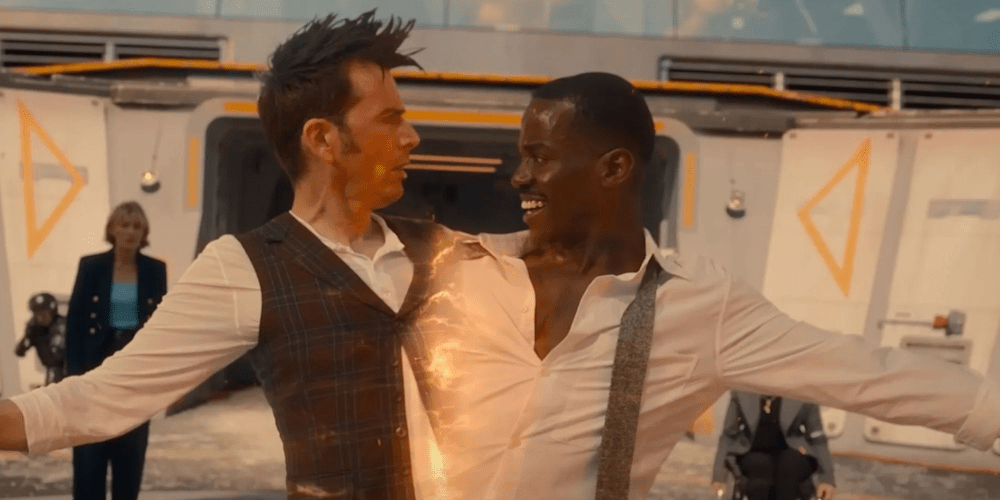
Bigeneration, described by one member as “kinda sexy, I can’t lie,” was a point of discussion for many members, whether favourable or unfavourable. The “rules of the Whoniverse” were regarded by some as a welcome sacrifice in the name of a compelling emotional resolution. Tennant’s weary Fourteenth Doctor was allowed the space to retire and rest with his loved ones, while Gatwa’s youthful Fifteen rode his new lease on life across the universe and into the next series. One commentator noted that Fourteen’s retirement metaphorically tied up the first thirteen series of New Who by giving this Doctor – and, by extension, his antecedents – a “happy farewell,” clearing the stage for Series 14* to debut in Spring 2024. Others didn’t quite “get” bigeneration, and yet others felt that Tennant being allowed to survive “felt a bit cheap.” (The resolution to Tennant and Tate’s return will be discussed below with regards to the whole trilogy. I, personally, wanted to see him explode on screen. Can’t have anything these days.)
More negative reviews (within the 4 to 5 range) criticised the episode’s shallow commentary on the evils of social media – although one positive review described the episode as a “savage satire of social media” and another as a “mirror held up to society,” a splitting of consensus foreshadowing later division over the themes of Dot and Bubble (2024). Neil Patrick Harris’ “sick” (NB – this is praise) performance as the Toymaker garnered appreciation, although not everyone was favourable towards the return of the long-awaited Classic antagonist, with one respondent deriding him as a “by-the-books manic villain.” His defeat-by-catch was regarded as “underwhelming,” reflecting a popular sentiment in the fandom. (I’ll confess my own perspective on The Giggle errs on the negative side, but I don’t understand this one. I thought the game of catch was a highlight of the episode.) In the words of one respondent, “I did in fact do a little giggling.”
Finally, praise abounded for Ncuti Gatwa’s debut as the Fifteenth Doctor – and deservedly so. Whether you loved or hated The Giggle, he was the episode’s breakout star: an otherwise negative reviewer opined that “Gatwa stole the show in the last 20 minutes and left me wondering why we couldn’t just have a run of specials with him instead.” Anxieties expressed by predictions that wondered how Gatwa’s introduction would be reconciled with Tennant’s return were mirrored by disappointment that “Fifteen didn’t get his big regeneration moment,” although Gatwa’s “warm and intelligent and energised” entrance into the show captured the hearts of all.
THE ANNIVERSARY SPECIALS, CONSIDERED TOGETHER (6.49)
“Omg yay, OMG yay, OH MY GOD” and “What 60th specials?” were both one-line reviews provided of the anniversary overall. The specials garnered a combined score of 7.16, comparing favourably to the 2022 specials’ 6.06 and Series 13’s (Flux) 6.49. (Unfortunately, we didn’t ask WhoSoc to rate The Day of the Doctor, the 50th anniversary special, back in 2013, else I would weigh up the scores here. The Three Doctors (1972/73) still wins for me, though.)
Anniversary specials are designed to commemorate the history of the show, acknowledge how far it has come, and set the stage for the future, so the recourse to story-powering nostalgia is an understandable one. Event episodes like these are usually integrated into the story arc of the current Doctor, but the preceding The Power of the Doctor (2022) ended Whittaker’s tenure before she could carry the anniversary, so the BBC had to think of something fast. Russell T. Davies had already conceived of a Tennant-Tate return, and the actors were enthusiastic about it, so their pitch was a natural fit for the 60th.
Inevitably, then, nostalgia and its role in the specials was a common talking point in reviews. Some members felt positively about Who’s decision to check up on some old favourites, with one commentator praising Davies for tying up loose ends, “revisiting some ideas…and adjusting them for more dramatic satisfaction.” It helped that the characters weren’t simply carbon copies of their 2008 selves, but had clearly grown and changed, engendering appreciation for “Tennant’s more thoughtful Fourteenth Doctor” and the “more mature and stronger Donna Noble.” Echoing earlier speculation in the Society group chat, one reviewer discussed their expectation that the specials would actively address the uses and abuses of pop-culture nostalgia, with “the Toymaker playing the role of a self-entitled fanboy who was responsible for the Doctor’s regression, perhaps highlighting the need to progress beyond the Tenth Doctor.” David Tennant is easily the most popular Doctor of the post-2000 era, and many fans who felt that the quality of the show declined under the direction of Steven Moffat or Chris Chibnall often mourn the good ol’ Tennant days. Of any actor to play the conduit for incisive commentary on the evils of unchecked nostalgia, Tennant would certainly have made it sting.
The specials didn’t do anything of the sort, and made instead for a relatively straightforward indulgence in nostalgia. The aforementioned reviewer was fine with this, lauding them as “three really enjoyable episodes that, while not flawless, revitalised this show once again.” Another thought that they were “solid…but not good enough to justify the return of Tennant or Tate, who are beloved by many but not particularly by me.” Even those who were glad to see Tennant and Tate return weren’t so sure about the approach taken to resolving the hanging thread of their relationship post-metacrisis. Someone would “rather both characters didn’t get such perfect endings” – and, as discussed under The Star Beast, others felt that simply handwaving the metacrisis out of the story by the end of the first episode was a poor decision, robbing Series Four of its climatic tragedy.
Whether or not it was worth building the 60th anniversary on the foundations of a single beloved Doctor-companion duo from 2008 is ultimately up to the individual viewer to decide, but Tennant and Tate make for an enjoyable, charismatic partnership regardless, and most people were ultimately happy with the quality of the specials. Reviews praised the use of the increased budget to produce a colourful and vivacious set of specials that demonstrated that Doctor Who could still be event TV, even in the streaming era, and the variation in tone between the three – The Star Beast’s family story, Wild Blue Yonder’s psychological thriller, and The Giggle’s world-ending showstopper – made for an engaging watch. Some people loved them, and some would rather not think about them ever again. Isn’t that, in the end, what Doctor Who fandom is all about?
One respondent declared that the specials had “utterly put their mind to ease about RTD’s return.” Luckily for them, Ncuti Gatwa’s first full episode as Fifteen debuted only 16 days after The Giggle. Onwards to The Church on Ruby Road and Series 14!
*The author has made the personal choice to refer to the 2024 season as Series 14 in these review articles, but Season 1, Series 14, and Season 40 are all synonymous.
 The Tides of Time
[…] the least speculation, but engendered the highest approval from our members next to its siblings (see our article reviewing the 60th anniversary specials). We knew very little about it going in, other than that there was a cool robot on the poster and […]
LikeLike