Adam Kendrick reads through the responses to Doctor Who’s fourteenth series, submitted by members of the Oxford Doctor Who Society.
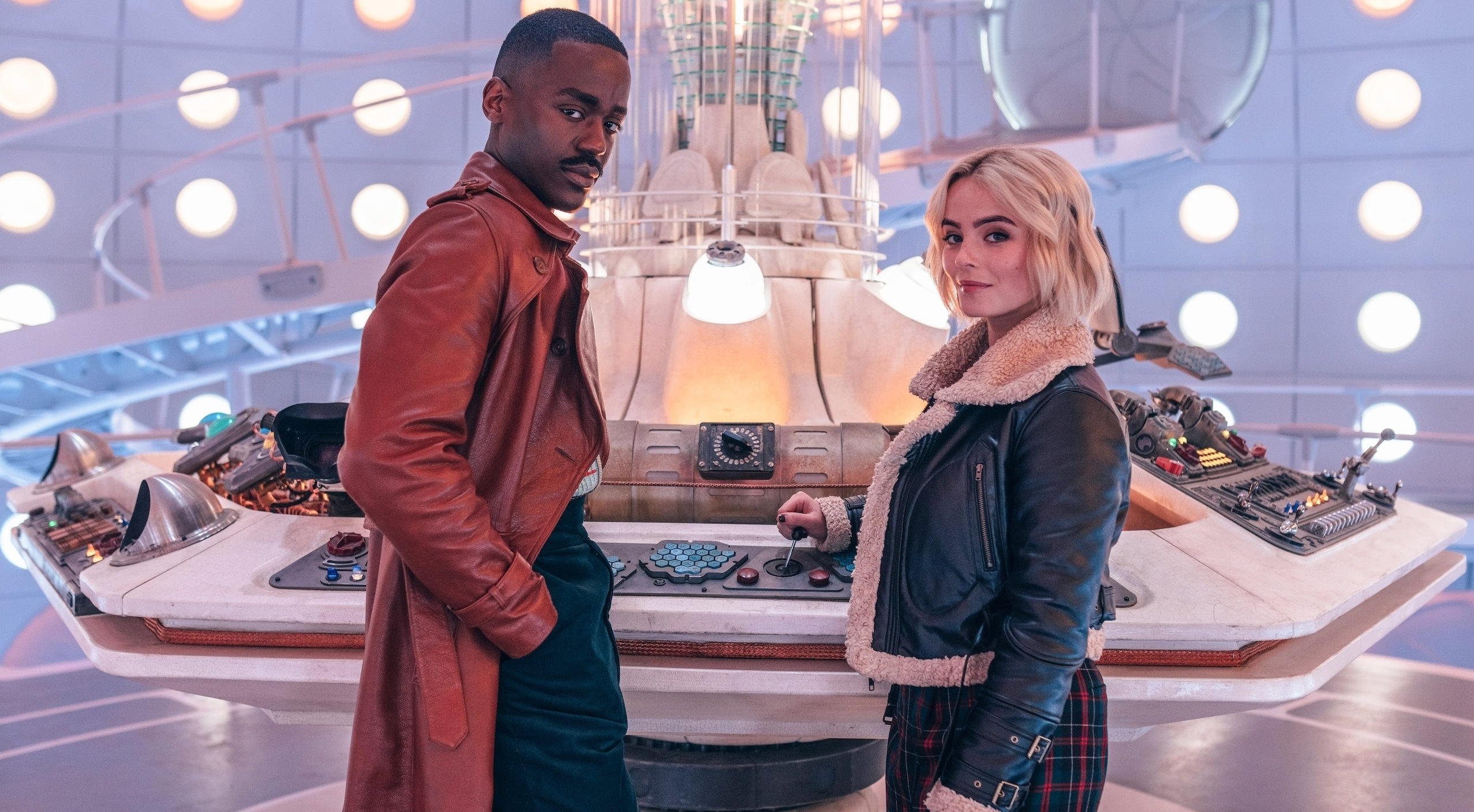
With Ncuti Gatwa receiving the keys to the TARDIS from David Tennant at the end of his debut appearance in The Giggle, there was only a two-week gap before the start of a brand new series of Doctor Who. Series 14 (or “Season One” as it was marketed) opened with the first Christmas special since Twice Upon a Time in 2017 and introduced the Doctor’s latest companion, Ruby Sunday played by Millie Gibson.
To find out what the Oxford Doctor Who Society thought about Ncuti and Millie’s first series, we sent out fortnightly surveys to our members asking them to rate each episode out of ten and encouraged them to submit their own thoughts. We also invited members to take part in an end-of-series survey following the broadcast of the series finale, Empire of Death, which allowed respondents to rate and review each episode, as well as Series 14 as a whole. A scale of one to ten was used, with one representing the bottom 10% of all New Who episodes and ten representing the top 10%, and an average score for all submitted ratings was calculated. In total, our end-of-series form received eleven responses, to which we added some additional episode responses which had been sent separately earlier in the year. All comments are quoted anonymously, but may have been paraphrased or edited for style and flow, while keeping their original meaning intact.
The Church on Ruby Road – 7.50 (eight responses)
Although the first Christmas special of this new era didn’t receive as many responses compared to the remaining episodes – perhaps due to the society taking time off for Christmas – it nonetheless received the most enthusiastic reception from our members, with not a single response rating it less than 7 and one respondent awarding it the maximum score of 10, commending it as an “absolute banger”.
The Church of Ruby Road was Ncuti Gatwa and Millie Gibson’s first episode together, in which the Doctor saved Ruby Sunday, an orphan who was abandoned at a church on Christmas Day, from being tormented by hungry goblins, before inviting her to travel with him in the TARDIS. There was plenty of acclaim for both leads: the new Doctor was described as “cute, enigmatic, and emotionally available”, “softer spoken than he was in The Giggle”, and having “more experience than ever”. Ruby Sunday was celebrated for being “brilliant with a confidence and depth beyond her years”, as well as having “a rich home life and excellent chemistry with the Doctor”. Although no other actors were specifically singled out for praise, respondents highlighted the “wonderful characters and performances from everyone involved” and hailed the special as “a very promising character-driven introduction to the new companion, reminding us what RTD [Russell T Davies] is best at”.
The ravenous goblins were another highlight, with one member suggesting that their presence “will have pleased bloodthirsty small children everywhere.” The decision to keep these mischievous creatures in the background of the story was applauded, since it allowed Ncuti and Millie to “upstage” them. Reaction to Murray Gold’s The Goblin Song was slightly mixed, with one response describing it as “excellent” and another saying they “wasn’t totally convinced”.
Overall, the Christmas special was widely praised as a “solid start to the new season”. Members considered it to be an “excellent introduction”, “satisfying”, “lively and engaging”, and “a deliberately low-key taster for the adventures of the Doctor and Ruby”. In fact, the only real criticism came from one member who felt it was “fun, but nothing special”, and that it had a strong start before resorting to “standard Christmas fare”. Finally, there was intrigue at the mysteries introduced for the upcoming series, from the identity of Ruby’s mother to the enigmatic Mrs Flood, with one member confessing their suspicion and distrust of every character, before adding “I think Ruby is a half-alien, not gonna lie.”
Space Babies – 4.47 (seventeen responses)
Five months after Christmas, Series 14 got underway with a double-bill of Space Babies and The Devil’s Chord. The opening episode, in which the Doctor and Ruby landed on a space station populated with talking infants and a literal bogeyman, became our lowest rated episode of the series – the highest rating that it received was a 7, while eight different members rated it a 4 or below. The most scathing response dished out the lowest possible score of 1, lamenting, “The absolute pits. What were they thinking of putting this one first?… The snot monster befits a child’s imagination and it should stay there.” Indeed, one member dismissed it as “a forgotten Sarah Jane Adventures script” that had been repurposed, while another described it as “an episode-long gag that should have just been a throwaway joke”.
As a series opener featuring a companion’s first trip into outer space, the episode was compared unfavourably against previous New Who episodes such as The End of the World (“a pale imitation”), Rose (“some moments with Ruby that felt like they were lifted directly”), and Sleep No More (“unlike that episode, this one doesn’t really make the horrors of capitalism seem, well, horrific, as everyone is all fine and friends at the end”). Others acknowledged that while the story had good ideas, “the execution left a lot to be desired” and that “mostly, it just didn’t hang together”. One member who was otherwise ambivalent felt that the “generally dull” plot lacked conflict or tension, and even suggested that Russell lacked the nerve to actually kill an infant and sufficiently raise the stakes.
Perhaps the most common criticism was directed towards the climax, in which the Doctor decides to prevent the Bogeyman from being ejected into the vacuum of space. The sudden pivot in the narrative from treating the Bogeyman as a scary monster to a sympathetic being that needed saving was viewed as “very hasty”, with one member complaining that “I can’t think what this is supposed to be doing emotionally other than telling us that babies are cute”. Other complaints were made about “the freaky CGI baby mouths”, the juvenile sense of humour, and the overall silliness in what would be many people’s introduction to Doctor Who (“Did we really have to start the season with THIS?”)
Nevertheless, there were still plenty of positive comments buried within these responses, such as “Not as bad as everyone says!” and “I don’t get why people don’t like this one. Was it the gross out humour? Are we all twelve years old?” The highest rated reviews described the episode as “energetic, funny, cutting, deceptively simple, and an argument for the kind of children’s storytelling Doctor Who is part of as well as for allowing children to grow up loved”, as well as “a really fun technicolour episode about babies…in space. You guys just hate fun.” Golda Rosheuve, who played Jocelyn, the last remaining crewmember of Baby Station Beta who vowed to protect the children, was specifically praised for being “amazing as always”, while another member said they loved the energy that Millie Gibson brought to the show and her interactions with Ncuti Gatwa. Indeed, there were compliments for how the episode showed heart, offered “a great opportunity for Ncuti and Millie’s characters to bring out their compassion”, and that it still worked as “a good introduction to the idea of Doctor Who for new audiences.” Perhaps the final word should be given to this pithy response, quoted in full: “You know something? Those babies sure were in space.”
The Devil’s Chord – 6.88 (seventeen responses)
Contrasting with Space Babies, The Devil’s Chord, in which the Doctor and Ruby visit Abbey Road in 1963 only to discover that Maestro, the god of music, had stolen the concept of music itself, received a much better reception. Only three respondents rated it a 5 or below, whereas one member awarded it the highest accolade of a 10, describing it as “unashamed fun” and praising the creative use of its villain. Other highly-rated reviews hailed the episode as simply “glorious”, for having “insanely clever grotesquery”, and for being “a very enjoyable and funny follow-up to The Giggle.” Others applauded the show’s willingness to break the fourth wall (“What fourth wall?”, asked multiple respondents), and Murray Gold’s soundtrack was praised as “beautiful, haunting and irritatingly catchy”, with highlights being The Life of Sunday – Ruby’s Theme and the “joyous”, “hilarious”, and “camp” finale of There’s Always a Twist At the End.
Although the presence of the Beatles was already known before broadcast, their full extent of their involvement, as well as how Russell T Davies would write around the legal difficulties which prevented their music from being licensed, had become a curiosity. While one member appreciated how “when the Doctor can’t save the world, the Beatles can!”, others were disappointed with their minimal participation with the narrative, beyond their main contribution of John Lennon and Paul McCartney showing up to defeat Maestro. One respondent suggested similar vibes between The Devil’s Chord and Yesterday, Richard Curtis’s recent film about a man who discovers that nobody else in the world remembers the existence of the Beatles, although they felt that the former was only partially successful. Another member went so far to suggest that until the BBC could secure the rights to the Beatles’ back catalogue, plans for a musical episode about the Beatles should have been shelved entirely, or at least reworked into a more outlandish premise, proposing an episode where “the Doctor and Ruby travel 300,000 years into the future to team up with insectoid alien tribute band, the Beetles”.
Some illogicalities in the plot were criticised, including the notion that the absence of music would lead humanity to nuclear armageddon (“perhaps only done for the sake of the series trailer,” suggested one response), the noticeable time skip that had seemingly occurred between Space Babies and The Devil’s Chord, and why the Beatles would even bother to record music if they hated it so much. Most of all, members were frustrated by a lack of payoff for “ominous lines that ultimately went nowhere” and the hidden song inside Ruby’s heart, which were both left unanswered. One member felt their opinion had slightly cooled since their first enjoyable viewing, admitting how “while the episode has some fun vibes, there isn’t really anything more substantial to it than that, and it probably won’t stand up well on a rewatch.”
Perhaps the most common criticism was reserved for the episode’s villain, Maestro. Multiple members criticised their conceptual similarities to the Toymaker, with one member stating how they felt “a lot like a rehash” and another suggesting that “the pantheon nonsense shows that RTD is trying too hard to burden us with lore.” These sentiments were shared by a second member: “I’m not sure we needed another campy reality-bending villain so soon after the Toymaker, y’know?” A third response observed how “having a second god show up two episodes after the Toymaker really makes them feel less special,” and that the impact of seeing the Doctor terrified of powerful and malicious entities would be diminished with every god defeated. The climatic musical battle against Maestro was described as “a bit disappointing”, “really underwhelming”, “slightly overlong”, and “cringe but fun”. One member highlighted its similarities with how the Doctor(s) managed to defeat the Toymaker by playing catch in The Giggle, adding “it was all a bit arbitrary and the Doctor didn’t necessarily earn a win”. Another member agreed: “if the Doctor is going to face a godlike entity, I want to see them actually outsmarting that entity and beating them at their own game, rather than winning through pure luck.” Nevertheless, Jinkx Monsoon’s performance as Maestro received near-unanimous acclaim for being “amazing”, “absolutely fabulous”, “such a presence”, and a “top tier villain”. To quote one response: “Jinkx Monsoon my QUEEN gave absolutely everything in every scene she was in, stole the whole goddamn show”
Boom – 6.87 (fifteen responses)
Steven Moffat’s nail-bitingly tense return to Doctor Who after the Twelfth Doctor’s regeneration story, Twice Upon a Time, received a broadly positive reception (“Moffat back to what he does best”, “Great achievement to get Moffat back as a guest writer”). In fact, with the exception of two responses, every submitted rating fell within the range of 6 to 8. The central premise, where the Doctor accidentally stands on a landmine and spends nearly the entire story standing still, was celebrated for being an “excellent concept”, having a “great thriller plot” and for being “a really compelling forty-five-ish minutes of drama and social commentary”. One member suggested that the “curiously old-fashioned” episode could have been adapted for the stage, complete with real holograms. Another member noted how the story succeeded in “showcasing the new Doctor (much needed given his absence from the next two episodes) because the focus is on him all the time”, similar to the fan-favourite Twelfth Doctor episode, Heaven Sent. Other members praised the story’s thematic depth, ranging from warfare, capitalism, technology, faith, fatherhood, and mortality, while Ncuti Gatwa and Millie Gibson’s performances were acclaimed as “superb” and “fantastic”.
A number of recurring tropes in Steven Moffat’s writing (or “Moffatisms”) were highlighted, such as “sexual quips”, “the Doctor having improbably superhuman mental and physical capabilities”, and the power of love saving the day. “The biggest drawback here is probably that it does feel very ‘Moffat’s Greatest Hits’, with a lot of ideas and plot beats that we’ve seen several times before,” summarised one member. “Steven Moffat puts all his past episodes in a blender and comes out with a novel concept, but one that feels retreading old ground at every step”, wrote another member, before lightly criticising the dialogue’s similarity to the Twelfth Doctor and Clara’s dynamic, the “cheap callbacks”, and recycling the conceit of deceased characters living on through AI.
Some criticism was also directed at the supporting characters: one member who otherwise loved the Papal Mainframe and Anglican Marines wished that “we didn’t have to watch a series of characters we barely know get knocked off in the last ten minutes before the Power Of Fatherhood could kick in. I don’t care about these random people who’ve had no screentime.” Other members felt that these characters were “not quite credible” or that there should have been fewer characters so that the episode felt more intense. The lowest rated review, which awarded a mere 2 out of 10, was the most scathing: “I can’t understand why anyone thinks this was brilliant. Lots of tense lines and acting with no discernible justification in the plot – spread thin with too many characters and too many niche references we didn’t get enough time to build on in the story for real emotional impact.”
73 Yards – 7.47 (fifteen responses)
The first of two consecutive “Doctor-lite” episodes, 73 Yards saw the Doctor mysteriously vanish after stepping inside a fairy circle on the Welsh coast, leaving Ruby to be followed by a mysterious woman who always appears standing exactly 73 yards away from her. This ended up being one of the highest rated episodes of Series Fourteen, with half a dozen respondents giving it at least a 9 and the lowest rating being a 5. The most adulatory review commended 73 Yards as “a genuinely astonishing and audacious Doctor-lite episode that’s masterfully directed and performed, and perhaps reaches the same heights as Heaven Sent” before awarding it a perfect 10. Similar sentiments were shared by other members, who described the episode as “unlike any previous episode, amazing”, “transcendent”, “the mysterious and haunting stand out of the season”, “a brilliant format-breaking spooky/mystery/A24 film of an episode”, and “one of my favourite New Who episodes. Stuck with me for ages after watching it.”
With Ncuti Gatwa finishing his prior commitments to the final series of Sex Education during early production, the Fifteenth Doctor’s absence allowed Ruby Sunday to take the spotlight, similar to how Donna Noble experienced her own alternative timeline without the Tenth Doctor in Turn Left. “Great to see Ruby shine and some genuinely scary, character building moments” approved one member, while a second member praised the performances: “Millie Gibson is tremendous, Aneurin Barnard brutal, and the entire sequence of events unnerving.” In fact, the only complaint about the Doctor-lite format was how it was a shame that the series didn’t have a second Ruby-centred story.
Several members praised the episode’s unique nature as “very interesting and atmospheric”, “jarringly weird”, and having a “good air of mystery”. From taking inspiration from Welsh folk horror, the unspoken rules of the curse were praised as being “part of the charm”, while the premise was summarised as “entertaining high-concept… folk sci-fi-fantasy?” Although one member felt the ending was a bit of a let down, there were also suggestions that the lack of explanation “adds to the overall mystery and vibe of the episode”, with one member expressing that “I have no idea what actually happened at the end and I hope I never found out.” Finally, we received this detailed analysis of its themes: “At times so horribly depressing and cruel that you just want to reject it but then there is something about the concept of the ever-present, unknowable threat that cannot be reasoned with that keeps grabbing your attention… It appears to be a gift to the world when Roger is defeated and there’s a sense that things “happen for a reason” but it turns into an entire life lived alone, concluding in muted acceptance rather than extreme anguish.”
Of the more critical responses, one member said that while they “loved the folk horror vibes of the first fifteen minutes” and appreciated Russell T Davies trying something different, they felt the episode began to lose them “as soon as we start getting the big time jumps and Roger ap Gwilliam stuff.“ Similarly, some responses lamented how the episode was “creepy and atmospheric at first, but runs out of steam a bit when some of the build-up doesn’t pay off (e.g. the scene in the pub)” before commenting that both the alternative lifetime and Doctor-lite scenarios had been done better in previous stories. Indeed, the political aspect was considered to be “somewhat weak but not enough to ruin the format completely”; in particular, there were two responses criticising the contrivance of having the Doctor coincidentally mention Roger ap Gwilliam moments before accidentally triggering the curse which sets Ruby’s entire life on course to stopping him. Either way, according to one respondent, the episode provided a valuable message for us all: “If you ever encounter a nuclear fascist, just sic the thematic manifestation of your deep-seated abandonment issues on ’em.”
Dot and Bubble – 6.64 (eleven responses)
Taking place in a futuristic society where everyone spends every waking moment staring into a holographic sphere, while remaining completely obvious about an invasion of giant carnivorous slugs, Dot and Bubble was perhaps the most controversial episode of the season, with our members rating it from a perfect 10 (“The STANDARD.”) to a dissatisfied 3.
There were plenty of comparisons with Black Mirror, the highly successful anthology series created by Charlie Brooker which uses technology of future dystopias to explore social issues. However, for many members, Russell T Davies’s attempts at social commentary simply didn’t land, with one respondent describing the episode as “incredibly cynical” and leaving “a sour taste”. The biggest criticism was how, to quote one member, “a lot of the episode is presented as a rather boomerish take on influencers and social media, with some cheap shots at ‘those darn kids and their phones!’” These sentiments were shared by another member, who criticised how “the episode spends its time ranting like a GB News article saying how kids these days are on their phone too much, and it’s painful to watch. If it was supposed to be about how social media bubbles radicalise people, it fails to get that across by being completely detached from how online radicalisation actually takes place.” A third member felt that influencers were an easy target for mockery and that “it took so long for anything interesting to happen… that I lost interest and didn’t pick up on the clues for the other reasons why [Lindy] should be disliked.“
Conversely, a number of members praised the episode, with the respondant which awarded it 10 out of 10 stating that “the mystery was enjoyable, the characters all evoked the right emotions…” and that it offered “a genuinely terrifying prospect of what the future could be”. Another member praised Dot and Bubble as “solid episode” with memorable characters “despite their once-off appearance (and high mortality rate)”, appreciated the “nice setting and aesthetic”, and was pleased that it offered a message beyond simply rebuking social media, although they also mentioned that they would have liked a more developed explanation for the invasion than ‘the dots hate you because you’re annoying”. Others simply enjoyed the catharsis of seeing bigoted characters being killed off by monsters, with one member explaining “Sometimes you just have to watch a micro-influencer nearly get eaten by the woke slug mob/walk into a pole/indirectly murder a larger influencer for fun.”
If there was any consensus amongst all these responses, it was centred around the final scene, in which the survivors of Finetime turn their back on the Doctor, despite having their lives saved by him, due to the colour of his skin. “The final few minutes are perhaps the most dramatic of the whole season and worth re-watching,” wrote one member, while another felt that the commentary on whiteness was far more important than the preceding swipes taken at TikTok influencers. A third member said that they “picked up on some of the Settler Colonial Racism subtext early on, so I thought the resolution was satisfying and put an interesting spin on the episode.” Even those who reviewed the episode negatively said they “wish the rest of the story was properly supporting [the ending] rather than making cheap ‘LOL kids can’t even walk without phones’ jokes.” In particular, Ncuti Gatwa’s performance was described as “astonishing”, “brilliant”, and “excellent”, with one member commenting that he “still managed to kill it” despite his limited screen time. That being said, there was a certain supporting character who might have upstaged the Doctor for one member, who confessed that “Dr Pee lives in my head rent free.”
Rogue – 7.91 (eleven responses)
Kate Herron and Briony Redman’s romantic romp in nineteenth-century Bath, with the Doctor having an all-too-brief fling with a mysterious bounty hunter known only as Rogue, ultimately earned the highest average rating of the series, with two respondents awarding it a perfect 10 and nobody rating it below a 6. “Having new blood in Doctor Who produces a very good episode, it turns out!” observed one member, while others exclaimed “very enjoyable, made my gay heart ache” and “fun, camp and crying my eyes out!”
The relationship between Ncuti’s Doctor and Jonathan Groff’s Rogue received significant acclaim and was summarised as both “15/Rogue speedruns the tragic romance arc with style” and “a Tenth Doctor-style pseudo-historical that’s wonderfully gay”. Even members who mentioned that they weren’t keen on romantic storylines in Doctor Who otherwise enjoyed the episode and praised the introduction of a gay love interest for the Doctor. Above all else, there was a strong desire amongst the society for Jonathan Groff (described as “hot and cool” by one respondent) to someday return, with one member observing how there was “plenty of future potential in Rogue” and another simply stating “The Doctor NEEDS to find him.”
Other responses discussed the Bridgerton-pastiche’s meta-commentary on fandom and cosplay (for both Doctor Who and Bridgerton), as well as the parallels between the Chuldurs, the Doctor, and their companions all treating the past as an opportunity to dress up. “Shapeshifting may seem like a desirable superpower but it leaves people without a sense of identity, acting out a fantasy created by other people, so as non-shapeshifters we should be glad of what we have,” observed one astute member.
If there were any criticisms, they were related to the Chuldur subplot, which some responses felt was lost due to the romance taking priority. There was a wish that more time could have been spent with the “campy bird people”, while one member felt that Indira Varma’s guest role as both the Duchess of Pemberton and the Chuldur leader who steals her form “was not hyped up enough”. A few members also felt the conclusion was predictable, since “it was glaringly obvious that Rogue wasn’t going to make it out of the episode in one piece”.
Nevertheless, Rogue was highly commended by the society for being “really funny”, a “joyous and well-executed tale,” and “a solidly entertaining story with a fun concept for the villains, and a nice star-crossed lovers plot”. And while there was praise for the “excellent” score and the “really solid” pacing and plot, there was one member for whom the scene in the spaceship was their highlight, especially because it featured the first appearance of Richard E Grant’s Doctor since Scream of the Shalka, which had hitherto been deemed to be non-canonical.
The Legend of Ruby Sunday – 6.09 (eleven responses)
Series 14 ended with the traditional two-part finale, which ramped up the stakes and finally began answering some of the questions that had been posed throughout the run. Not only did The Legend of Ruby Sunday reveal the truth behind why the mysterious Susan Triad had been making cameo appearances in nearly every preceding episode, but it also revisited the night when Ruby Sunday was abandoned by her mother. This was another episode that received a mixed reception from the society, ranging from “a very enjoyable episode for its buildup” to “a whole lot of nothing, really.” Generally speaking, it seemed that members felt that the episode was underwhelming and wouldn’t stand up to repeat viewings.
Most of the complaints focused upon the amount of time which was spent recapping the events from The Church on Ruby Road, an episode which had been broadcast only six months previously. “Mostly a lengthy build-up to a cliffhanger that repeats information that we already knew”, began one response, while another chastised the execution: “The beginning is almost painfully clunky, with all the characters gathering in a room and delivering exposition to remind us what the big mysteries of the season are, and then the rest of it doesn’t really get any better.” This criticism was extended to how the viewers were periodically teased with red herrings about Susan Triad’s identity, with one member describing the narrative as “clunkily bouncing between the two main subplots of the series” (although they added that the flashback to Ruby Road had “a very nice atmosphere”). On the other hand, a different member praised the “fascinating idea of creating a lost past from nothing and using that to definitively solve the mystery of Ruby Sunday. And then use that to uncover a dark secret that sets up the cliffhanger.”
And of course, there was the climatic return of Sutekh the Destroyer, last of the Osirans, first seen in 1975’s Pyramids of Mars, and still voiced by Gabriel Woolf. Indeed, the final fifteen minutes were described as being “very strong” and multiple members enjoyed the build-up to this exciting reveal. One member who rated this episode 8/10 simply submitted the word “Sutekh!!!!”, while another observed that considering the entire story hinges on the reveal, they had to concede that “it’s a damn good reveal”. Conversely, one respondent was disappointed that they had been promised “compelling character development for Ruby Sunday rooted in the progression of her series-long myth arc”, only for this to be superseded by “the sudden reintroduction of a Classic villain from 1975”. Another member who otherwise described the slow build-up as “intriguing” criticised Susan Twist’s makeup once she became possessed, dismissing it as inferior to Bernard Archard’s appearance as Marcus Scarman in Pyramids of Mars, before adding that simply reciting dialogue was not enough to replicate the magic of the original serial.
When it came to UNIT’s involvement, one member wished that UNIT had done more than simply “agreeing with the Doctor and inexplicably employing children… Where is the old conflict between the Doctor and a military taskforce, two entities who should clash because of their differing ethics and priorities?” (before adding “Still hate UNIT Tower”). On a more positive note, there was a specific shoutout to the Vlinx, and Lenny Rush’s Morris Gibbons was praised for being “the star of the show” by one member, who also complimented how “everyone’s performances were great throughout.”
Empire of Death – 4.50 (eleven responses)
The final episode of the series, in which the Doctor faced off against Suthek and restored life to the universe, was met with a significantly lukewarm reception, with all but three respondents rating it a 5 or below and nobody awarding more than 7. The most scathing review gave this episode a mere two out of ten, stating that “it embodies everything I really dislike about RTD’s writing (except his inclination towards randomly marrying off characters, from which we were happily spared)… It wasn’t even funny to make up for it”. Another review simply consisted of a single word: “What.”
The most common criticism related to the opening scenes, in which Sutekh brought his gift of death to all humanity: “As soon as all the main characters at UNIT get vaporised, it’s immediately obvious that Sutekh’s death wave will be reversed somehow, which undercuts a lot of the tension”, pointed out one response. “Great opening moments, which nevertheless make it a bit too obvious that a big magic reset button will be used”, agreed another. Other complaints revolved around Sutekh’s lack of involvement in the story and the manner in which the Doctor defeated him. “Why bother bringing back Sutekh if you aren’t even gonna do anything cool with him”, lamented one member, while another member argued that Sutekh “did not feel threatening at all, was defeated too easily, and having the world reset is again poor writing (and is so common for RTD episodes at this point it takes away any emotional investment).” Similarly, other responses stated that “the villain is cheapened at the end and the notion that erasing death brings life works only for the first minute of thinking about it” and that “Bringing death to death is as much an RTD deus ex machina as we have ever had.”
When it came to the identity of Ruby’s mother, one of our members opined that “RTD clearly wanted to misdirect the audience, which is fine; however, having the mystery of Ruby’s parentage built up and intriguing even the Doctor… then simply dismissed was cheap and lazy writing.” Another member felt that the resolution to this arc was “very disappointing, because of the magical hints that have now gone unexplained”. Indeed, if Ruby’s mother really is an ordinary woman, what’s with the snow? [Sutekh and the TARDIS, I imagine. – Ed.] More specifically, one member called out the revelation that Ruby’s mum named her own daughter by pointing at a lamp post as being “really stupid”.
Overall, the finale was seen as a bit of a disappointment. “In true RTD fashion, things don’t get resolved quite as satisfactorily as they could have been, with too much emphasis on the feel-good factor”, wrote one response. The emotional farewell between Ruby and the Doctor fell flat “because there hadn’t been enough development to make that kind of scene feel earned”, while another member felt that “the emotional beats didn’t land well enough for me to overlook the messiness of the plotting.” Perhaps the best summary came from this member: “Pretty much what you’d expect for a series finale written by RTD: excessively raised stakes, clear plot holes, and a deus ex machina that’s signposted from the very beginning, but entertaining and well-performed nonetheless.”
Still, there were a few points of praise scattered between these responses: one member praised the “individual scenes, particularly that of the Doctor and the Kind Woman, held together by RTDs strength of will”, before adding their relief that David Tennant’s Fourteenth Doctor “stayed in his shed” for the duration of the finale. One critical member liked the memory TARDIS, confessed that they teared up a little at the otherwise “annoying” resolution to Ruby’s arc, and felt that Mel saved the episode for them (although a different member complained that the character had been given nothing to do). There was a response which stated that the “theme of things being made real again from fragments of memories is interesting to contemplate”, while another was intrigued by the finale scene, in which Mrs Flood directly addressed the audience with a foreboding message about the Doctor’s future: “Will that lead anywhere? Are we still in/about to exit the mavity universe?”
Series 14 Episode Rankings
| Ranking | Episode | Mean Rating |
|---|---|---|
| 1 | Rogue | 7.91 |
| 2 | The Church on Ruby Road | 7.50 |
| 3 | 73 Yards | 7.47 |
| 4 | The Devil’s Chord | 6.88 |
| 5 | Boom | 6.87 |
| 6 | Dot and Bubble | 6.64 |
| 7 | The Legend of Ruby Sunday | 6.09 |
| 8 | Empire of Death | 4.50 |
| 9 | Space Babies | 4.47 |
Series 14 overall – 6.27 (eleven responses)
As our individual episode rankings indicate, the society’s overall reception to Series 14 was mixed and diverse, with certain episodes (Rogue and 73 Yards) being adored by the majority of members and other episodes (Space Babies and Empire of Death) receiving more criticism than praise. It should be no surprise, therefore, that when members were asked to rate the series as a whole out of ten, the average landed somewhere near the middle, with equal numbers of members giving ratings of 5 and 7.
“Really enjoyed this series of Doctor Who”, wrote the enthusiastic member who awarded the series the highest submitted rating of 9. “Loved how every episode felt completely different from each other, and both Ncuti Gatwa and Millie Gibson’s performances were absolutely incredible.” Another member was equally laudatory: “Strong start, interesting new Doctor, decent scripts, great acting. Go Gatwa! I particularly liked the costume changes”. A third member agreed that the series represented “a strong new start for Fifteen and Ruby” and although not all the mysteries came together, the run of strong episodes during the middle (with the exception of Dot and Bubble) would “leave a strong legacy to go forwards into Series 2”. These sentiments were shared by a fourth member: “Highs and lows with a disappointing finale but an enjoyable series with some top tier episodes”. Ncuti Gatwa received specific praise for being “an absolutely stellar Doctor” from one member who also appreciated the range in tone, the variety of episode concepts across the season, and the cinematography.
On the other hand, there were members who had more mixed opinions on Series 14 as a whole. “Some great episodes mixed in with some not so great. Finale and overarching plot was a bit weak in the end, at its best with the standalone plots,” wrote one respondent. “Overall average to mediocre, with a few standout episodes. I didn’t find it particularly thematically or narratively engaging,” wrote another. A few members were somewhat disappointed: “Not quite the brand new start I was hoping for. A lot of miss-fires, especially Space Babies. A good variety of different types of story… but disappointing climax that doesn’t answer the major questions about Ruby’s Mum.” The reduction in the total number of episodes from Series 12’s ten to eight was lamented, especially considering how “the Doctor was effectively absent for two of them”. Furthermore, with respect to Bad Wolf Production’s fast-paced production schedule, one member suggested that “recording two seasons in advance of broadcast now seems to be folly rather than confidence, since anything we don’t like in Series 14 will also be in Series 15.”
Perhaps the biggest complaint was a lack of narrative cohesion between the episodes. To quote one response: “while there were definitely some individual moments and episodes that I liked, I thought that the season as a whole was very messy, and was ultimately less than the sum of its parts.” And although Millie Gibson’s performance was commended, some members felt that Ruby as a character felt “very underwritten… her relationship with the Doctor was severely underdeveloped” and “left a lot to be desired”, which according to one member was “odd given that RTD has a history with compelling protagonists.” One member expressed their hope for a future showrunner who hadn’t been involved with Doctor Who before and can bring a fresh approach to the show: “This isn’t to criticise Russell T Davies or anything, but after watching Series 14, it seems clear that his approach to Doctor Who hasn’t fundamentally changed. I felt that he was repeating a lot of things he had done during his previous tenure.” However, if there was one consensus that the society could agree on, it was that the show was a lot of fun to watch.
Excited for Joy to the World?
Finally, we asked members whether they were looking forward to the upcoming Christmas special, Joy to the World, which at the time wouldn’t be aired for another six months. Responses were evenly split from excitement (“Looking forward to what will likely be the highlight of my Christmas”) to cool reservation (“I am always excited for new Doctor Who.”) to cautiously optimistic (“Eh, I’ll watch it, might be good. No expectations though.”). Some members had apprehensions about the likelihood of having “Steven Moffat at his most self-indulgent”, with one commenting that “Moffat’s previous Christmas specials have been very hit and miss for me, so I’m hoping this will be one of the hits.” There were hopes for explanations about Mrs. Flood’s identity and even a few predictions: members suggested that Mrs Flood would be revealed to be The Meddling Monk, that it would feature “a dark and sad plot revolving around Nicola Coughlan’s character”, a brief cameo from Ruby, and perhaps the title being repeated throughout the episode like a catchphrase. And although we now know which of these predictions came true, it’s easy to forgot how long we had to wait for those answers. In the words of one response: “Christmas… that’s a lifetime away… ask again in November!”

