Dan Evans reports on Christopher Eccleston’s visit to the University of Oxford.
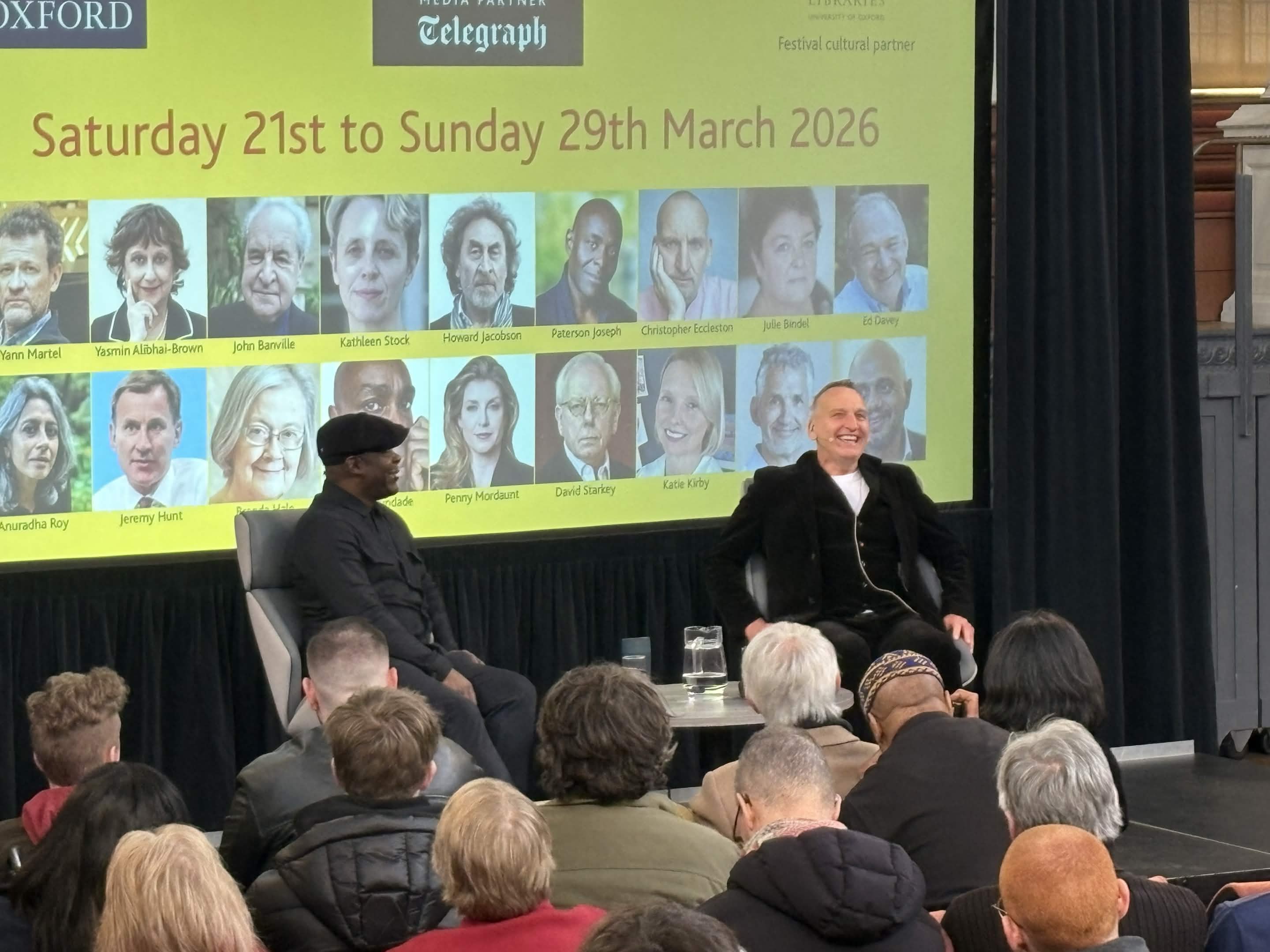
On paper, a discussion between Christopher Eccleston and Paterson Joseph at the Sheldonian Theatre for the Oxford Literary Festival may seem a bit out of place. Nevertheless, having two avid thespians from working-class backgrounds proved to be exactly the discussion that was required for the University of Oxford. The hour-long conversation was both engaging and insightful, leaving much food for thought on the current climate of the theatre industry and contemporary global issues.
The event was held on a cloudy Sunday afternoon on March 29th, 2026 as one of the final talks at the Oxford Literary Festival, an elegant, atmospheric festival which celebrates literature from many prolific authors and playwrights including Michael Morpurgo and Michael Rosen. An irony of the event was that several speakers, laid on the screen behind Eccleston and Joseph, were Conservative figures such as Penny Mordaunt, Sajid Javid, and Jeremy Hunt; politicians from a political party that Eccleston actively dislikes on social media and in interviews.
Conducting Christopher Eccleston’s interview was Paterson Joseph, an actor who has performed in hits such as Peep Show and BBC’s Noughts and Crosses as well as films such as Wonka and the upcoming The Mummy. He also appeared alongside Eccleston in his final two-parter, Bad Wolf and The Parting of the Ways, as Rodrick; a self-obsessed, greedy character who would later be exterminated by the Daleks. Fortunately, the actor proved to be the exact opposite of his Doctor Who character, with the added benefit that there wasn’t a single Dalek in sight to worry about.
Whilst Paterson and Christopher are not particularly renowned for their career in literacy, it is important to note that both have committed pen to paper in published formats. Joseph, in 2022, wrote a highly-acclaimed debut novel called The Secret Diaries of Charles Ignatius Sancho about the first black man to vote in Britain. Eccleston, in 2019, wrote a personal memoir, which played a crucial part in the talk.
The discussion was held at the Sheldonian Theatre, one of the University of Oxford’s most prestigious theatres. As Joseph recalled, Oscar Wilde performed and showed off at this very venue. Eccleston appeared somewhat impressed, helping in to delve into the historical significance of the place. During the introduction, Joseph introduced himself as the President of ‘the other university’, referring to Oxford Brookes University. This led to a few whoops and cheers from Oxford Brookes alumni (myself included) along with a few silent mumbles from the Oxford ‘elite’.
Eccleston mentioned that he had just come from the Chicago Comic & Entertainment Expo. More recently, however, he had made some waves on social media after pulling out of the Birmingham based Sci-fi convention, Flux, due to not being paid. As it would later appear, this proved to be something of an ‘elephant in the room’ for Eccleston.
The focus then shifted to Eccleston’s memoir, ‘I Love the Bones of You’ focusing specifically on Eccleston’s relationship with his late father, Ronnie Eccleston, and his struggle with dementia at the end of his life. The title is taken from the words that Ronnie once said to Eccleston when he escorted him to his car in his later years. It’s a Manchurian expression of endearment from a man who previously struggled with expressing his love. The moment clearly lives strongly in Christopher Eccleston’s memory, notably as a brief instance when the haze of dementia appeared to momentarily clear from his beloved father.
Points of Discussion – the life and times of Christopher Eccleston
Family life was a particularly important topic throughout the talk, with Eccleston coming from a working-class background in Salford. He mentioned that he felt somewhat like an outsider, as he was the only one not paired with someone, unlike his identical twin brothers who are eight years older, and given that his parents remained close together throughout their lives.
He talks about how his parents were incredibly supportive of his decision to become an actor, especially at the time where it was common for children to follow their fathers’ footsteps in terms of career. He wondered for a moment whether this decision was influenced by his father’s own experiences as a “social experiment”, where state school pupils were sent to private schools, leading his father to explore talents such as boxing and acting. His mother’s creative talents, on the other hand, were said to lie in the culinary arts, particularly in preparing ‘exotic’ dishes such as spaghetti bolognese, moussaka, and lasagne. Eccleston said his mother, Elsie, will be 94 in August. He described her with the phrase “all the chairs are at home”, meaning that she is mentally well and sound. Clearly, he is still very proud of her.
Although there was a brief reference to Eccleston’s experience as a central midfielder for Salford Boys during his teenage years (where he described himself as a “show-off”), inspiration from the likes of fellow Salford-born actor Albert Finney encouraged Eccleston to pursue a career in acting and theatre. Leaving Salford behind, Eccleston recalls that he later went to London and trained at the Royal Central School of Speech and Drama, where he said he became exposed to the works of Chekhov and Arthur Miller. While he loved his time there, he suffered from significant imposters’ syndrome and didn’t realise he was working class until he went to drama school (with Joseph sharing a similar experience).
Eccleston talked about his time after drama school, where he was “unemployed and listening to The Smiths” for three years. He confessed that during this time he struggled with anorexia and partook in shoplifting. He was caught in an actor’s Catch-22 in that he could only acquire work until he got an Equity card, but could only get an Equity card after he had acquired work. Eventually, he was offered the part of Pablo Gonzalez in the Bristol Old Vic’s production of A Streetcar named Desire, which led to a leading role in the film Let Him Have It (1991), where he played Derek Bentley alongside Doctor Who alumni such as Michael Gough and Murray Melvin.
From there, his career leapt upwards, with notable roles such as Nicky Hutchinson in Our Friends in the North (1996), working alongside Daniel Craig and David Bradley, who played William Hartnell in An Adventure in Space and Time (2013) and the First Doctor in Twice Upon a Time (2017) and The Power of the Doctor (2022). Peter Vaughan, who played his father, turned out to be a highly influential figure for Eccleston. He talked about the respect Vaughan had for all people on set, and explained that Vaughan would always announce “crossing camera” to the crew whenever he walked across camera as a sign of respect; a habit which Eccleston has adopted himself. In a respectful response, he says the cameraman will ensure you are properly lit in return.
Other works that were touched upon included Eccleston’s role in Heroes (2007), where he felt every actor on set looked like a model, except for him, and appearing in the theatre. Despite having less prominence compared to film and TV, he noted that limited funding often results in better behaviour among theatre actors. Eccleston talked about the adrenaline rush of performing on stage, comparing it to “playing for Manchester United” and pushed upcoming actors to engage in as much theatre experience as possible. Joseph also explained how it’s much harder yet more rewarding to act on stage than in film and television, because camera angles can literally ‘crop out’ certain body parts and angles, meaning certain acting muscles are relaxed. In theatre, however, there is no exception and every aspect is on show. They both agreed; if you can perform on stage, you can perform anywhere.
Whilst Doctor Who was not the forefront of the agenda, Eccleston had a lot to say about conventions, especially with the Flux situation mentioned earlier. He expressed his love for the fans and their desire for a personal, genuine connection with their ‘first’ doctor as well as how meeting these people can be an “emotional” and “interesting” experience. He wasn’t ashamed to say he was “doing it for money” and had originally refused to do conventions for ten years, until he “had to do it” to pay for his divorce. Unfortunately, the world can be exploitative and “totally corrupt”; on the subject of Flux, Eccleston stated “I wasn’t paid – simple as”. He said that he encouraged disappointed fans to ask the organisers for a refund on Instagram, and if they refused, the fans should speak to him directly on social media.
The final point of discussion revolved around Eccleston’s future, where he mentioned an upcoming role in Sky’s Meantime based on Frankie Boyle’s debut novel set in Glasgow, as well as an upcoming Netflix series called Unchosen, based around fundamentalism and corruption. Eccleston expressed his excitement of playing a humanised villain rather than a two-dimensional ‘baddie’.
Questions from the audience
As time began to wrap, one of the first questions brought to Eccleston was from a school librarian on the topic of helping underprivileged children to pursue the arts. Eccleston recounted a recent news article where Tate Liverpool brought a piece of artwork to underprivileged children in Salford, exemplifying how bringing art to children boosts their engagement with the arts; the art comes to them, rather than the other way round. Furthermore, he emphasises that drama should be utilised in schools as a means of shaping well-rounded individuals, rather than merely treating it as a hobby or specialised subject, thereby fostering the development of social skills and empathy amongst the younger generation, a matter which he was clearly passionate about.
Inevitably, a Doctor Who question was announced regarding Eccleston’s potential appearance in a future anniversary special. This was clearly a question Eccleston had heard a dozen times before and was getting familiar with relaying the same response about returning to do the 100th anniversary special “if I’m not running the London Marathon the same day”. He also mentioned that he would return to the show “tomorrow” if a woman becomes the next showrunner.
The final question of the evening revolved around Eccleston’s performance as Scrooge in A Christmas Carol in 2023, which Eccleston reminded the audience that Joseph had also played the same role at The Old Vic four years’ earlier. They talked about their experiences playing Scrooge, and how Alastair Sim’s “narcissistic” and “psychopathic” approach was hugely influential with Eccleston. Joseph also shared a funny anecdote during one of his matinee performances in the role, where he was enraged at a child’s teddy bear mid-performance. Eccleston responded, amusingly, with “The Kid’s in Broadmoor now.”
Conclusion – From Working-Class roots to the Oxford Stage
Paterson Joseph ended the talk with “this has been too brief”, and I, being sat in that glorious theatre, could not have agreed more. It really felt like Eccleston was at one with the audience, talking with us rather than at us. Like many others, I was starstruck to see him walk up to the theatre upon entry, and then in a matter of seconds I felt like I had known him much longer. Not only is he passionate about the people that made him into the man he is today, but he also nods to the future, and how drama should play a vital component in shaping younger audiences.
Much like his memoir, which is a great read for Whovians and non-Whovians alike, Eccleston provided a truly heartfelt narrative during their conversation, and it wonderfully demonstrated his empathetic and caring nature as a family man with ambition, alongside an unbound passion for theatre and the arts.
 The Tides of Time