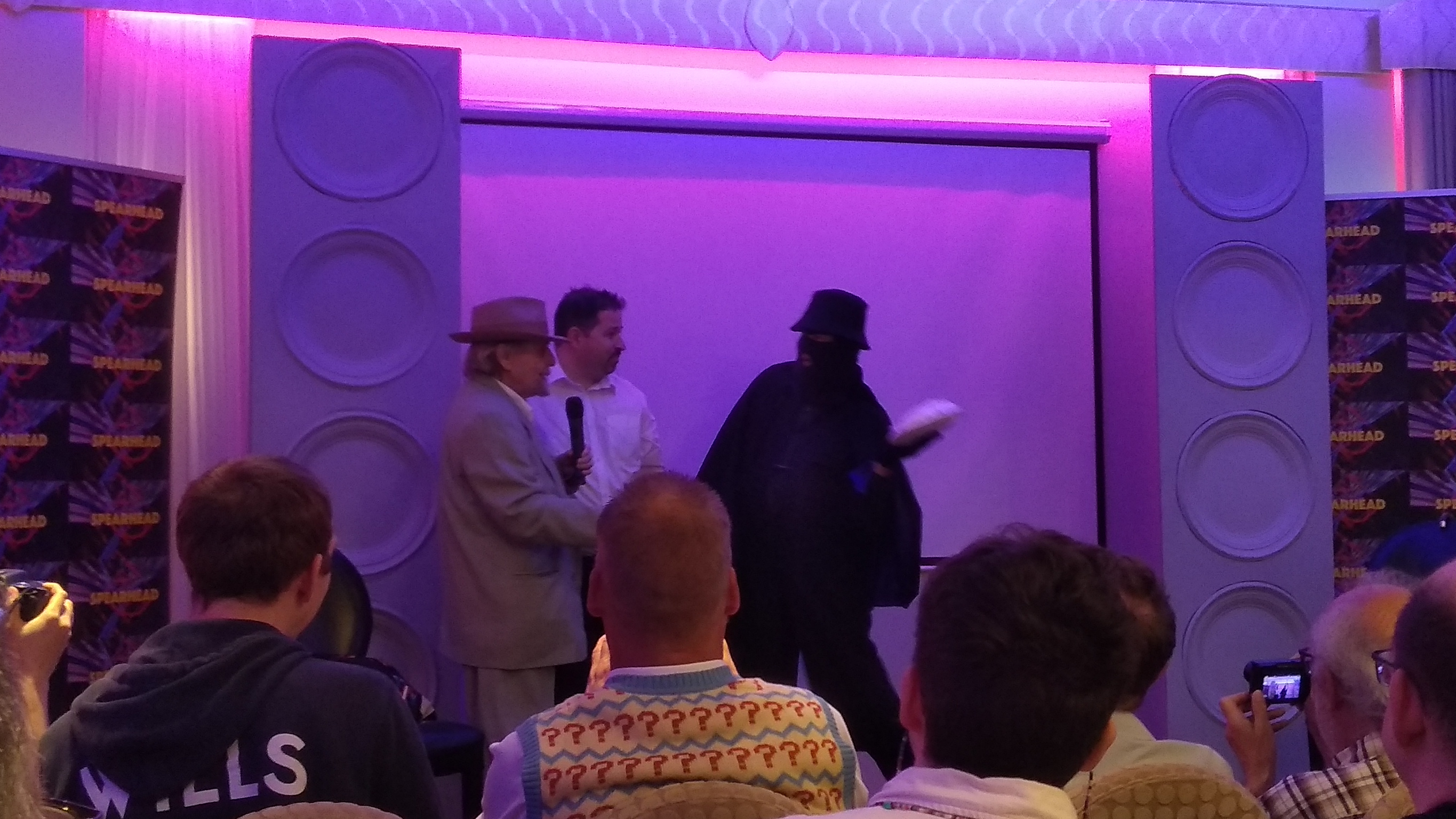
On Saturday, May 2nd, 2026, the Spearhead convention took place at The Wood Norton Hotel, Evesham, a Grade II listed mansion which functioned as the BBC’s emergency broadcasting centre during World War II, before it was later used in location filming for Spearhead from Space (1970) and Robot (1974-1975). With Sylvester McCoy appearing as a guest, we were taken on a journey across his television career that spanned more than fifty years. Adam Kendrick reports…
By the late 1960s, Sylvester had dropped out, become a hippie, and was working in the box office at The Roundhouse in London. Upon meeting Ken Campbell, he became a member of the experimental theatre troupe, The Ken Campbell Roadshow and adopted the stage name, “Sylveste McCoy”. He discovered that he had an innate ability for physical comedy, as he performed circus tricks and stunts such as hammering nails up his nose – sword swallowing was considered, but required three months of training and was too gross to learn. Since the other members knew how to play a musical instrument, this was where he first learnt to play the spoons. These self-taught skills came in useful when he made his first television appearance during Vision On (1964-1976), a successful and long-running children’s show aimed specifically at the hard of hearing (although he mentioned that the show was cancelled three years after he joined in 1973, which wouldn’t be the only time this happened to him.). Working alongside the beloved television presenter and artist, Tony Hart, he performed as a mime artist as he squabbled over deck chairs on the beach and dangled off ski lifts in the freezing Swiss Alps.
In 1975, he appeared alongside David Jason in the pilot for Lucky Feller (1976), a sitcom which is often cited as the precursor to Only Fools and Horses. Sylvester met the writer, Terence Frisby, after he briefly joined the Ken Campbell Roadshow during a very unhappy divorce and was cast as the incredibly drunk friend who gatecrashes David’s date at a Chinese restaurant; Sylvester conceded that his performance was “a bit over-the-top”, although he revealed he did once buy a house in France while drunk, partly because it turned out to be “bigger on the inside”. Lucky Feller was one of the few times he was credited as “Sylveste McCoy”; while portraying Stan Laurel in a 1980s stage play called Gone With Hardy, he discovered that this legendary film comedian changed his name from “Stan Jefferson” because it consisted of thirteen unlucky letters, which inspired him to append the ‘r’ to his own first name.
A few years later, Sylvester McCoy was making regular appearances on the anarchic Saturday morning kids show, Tiswas (1974-1982) – the clip which was played showed him dressed as a flower while Lenny Henry covered him with “pig manure”, had water thrown at him, and corpsing as Sylvester lost his balance and fell over. Sylvester described the experience as “madness” but due to his busy work schedule, he had no idea whether anyone actually liked the show until the following year, when some scary-looking skinheads hanging outside a fish-and-chips shop recognised him and offered him a chip. During this time, he also played a Teddy Boy in Big Jim and the Figaro Club (1981), a short-lived sitcom about a gang of builders set in the 1950s, and starred in various adverts for Kraft sausage rolls, Carling Black Label, and Knorr stock cubes – the latter of which became so ubiquitous that some people recognised him from this 42-second advert instead of Doctor Who!
One of Sylvester’s more serious roles was portraying Lieutenant “Birdie” Bowers in The Last Place on Earth (1985), a serialised drama about Captain Robert F. Scott’s (played by Martin Shaw) doomed exhibition to reach the South Pole in 1912. Since filming took place on Baffin Island in the Arctic, the cast and crew were subject to very similar conditions to the expedition itself. Describing the experience as “glorious”, Sylvester recalled how the cast had to undergo four hours of make-up to make their skin look rotten and takes being ruined by Martin’s flatulence, which was exacerbated by his vegetarian diet. This drama was only ever broadcast once, which Sylvester believed was due to how it controversially suggested that Scott’s poor planning was ultimately responsible for the deaths of himself and his companions.
Another serious role came in Three Kinds of Heat (1987), a crime comedy where he played a villainous gangster dressed smartly in a white linen suit and fedora – not unlike the outfit which his Doctor would be described as wearing in the Virgin New Adventures. Despite receiving negative reviews, Doctor Who fans might be intrigued to know that this film also features Trevor Martin, who had previously played The Doctor on stage in Doctor Who and the Daleks in the Seven Keys to Doomsday (1974) and Mary Tamm (Romana I), whom McCoy regretfully had to shoot with a machine gun.
In 1986 and 1987, Sylvester played The Pied Piper at the National Theatre, during which he rapped and danced while wearing a colourful coat that was suspiciously similar to a certain Time Lord’s. During one fateful performance, John Nathan-Turner happened to be in the audience on the recommendation of McCoy’s agent and knew afterwards that he had found his next Doctor. Sylvester was called in for an audition, followed by a screen test where we can first see the glimmers of his Doctor’s seriousness. And although Colin Baker refused to participate in Time and the Rani (1987), the two of them would later meet for the first time at a Doctor Who convention in Cleveland, 1990 where they recorded a short sketch where the Sixth Doctor “regenerates” into the Seventh.
Although being a Time Lord was a full-time job, Sylvester also presented and narrated What’s Your Story? (1988), an interactive children’s show where viewers could submit ideas and see them being turned into twenty minute escapades on live television. With a very short timeframe to write the scripts, build the sets, and learn the lines for each episode, Sylvester found the experience “great, but terrifying”, admitting that he seems much calmer on screen than he actually was. He even recalled a fire breaking out during broadcast and being told to stretch out the segment until it had been addressed, which he did by slowing down his line delivery. Sticking with children’s television, both he and Sophie Aldred later presented Search Out Science (1990) while in-character as the Doctor and Ace, meaning that this educational show technically became the only new Doctor Who to be broadcast in the year after the show was quietly cancelled.
Sylvester continued to make guest appearances in Scottish sitcoms, such as a long-lost brother who had escaped from a mental asylum in Rab C. Nesbitt (1988-1999) and an elderly recluse who hadn’t left his home in forty years in the award-winning Still Game (2002-2007). In the latter, his character is introduced to the wonders of modern conveniences such as microwaves (which don’t work) and McDonalds (which required plenty of acting on Sylvester’s behalf, since he hates their food in real-life). Perhaps his most memorable guest appearance from this period was in the long-running daytime soap Doctors (2000-2024), in which he sent himself up by playing a retired actor who played a time-travelling lollipop man in the 1980s, but is now more likely to be mistaken for Jon Pertwee.
Outside of television, Sylvester performed alongside Sir Ian McKellen in the Royal Shakespeare Company’s production of King Lear (2007-2008). Naturally, he played The Fool, a role which he found challenging due to the difficulty of learning the lines and how Shakespeare’s jokes “don’t travel through time” by themselves. This production apparently included real goats, which managed to upstage him by eating the set during one of his monologues. Finally, the panel ended with a clip from The Hobbit: An Unexpected Journey (2012), which Sylvester keenly reminded everyone that he had appeared in. He was especially proud of the scene where Radagast the Brown rescues and nurses an injured hedgehog called Sebastian, since this dramatic sequence featured him performing with no other actors other than a stuffed prop. When he watched the finished film with his children in the cinema, however, he was slightly annoyed to see that the prop had been replaced with a cute CGI hedgehog – once again, he had been upstaged by animals!

